The short version
With appliance leak water damage in Houston, shut the appliance valve or the house shutoff first, then turn off the breaker if water is near outlets and photograph the scene. A plumber or appliance technician handles the unit, and a restoration provider handles the water. Mold is avoided by drying wet materials in the first 24 to 48 hours.
What should I do first when an appliance leaks?
Shut the water off at the appliance, make the room safe, and then record what you see. Appliance leaks creep under flooring and into cabinets without much noise, so the opening minutes count for more than the cleanup does. Two different trades get calls afterward, one for the machine and one for the water.
- Turn the appliance's own valve. Washers, dishwashers, toilets and ice makers all have a small valve on their supply line. When it will not budge, close the house shutoff.
- Kill the breaker if water has reached outlets or cords, provided you can get to the panel without standing in water.
- Take photos and video of the appliance, the path the water took and each wet surface before you move anything.
- Get rugs and boxes off wet flooring and blot standing water with towels.
- Phone a plumber or appliance technician about the unit, and a restoration provider about the water.
Extraction and drying fall to a restoration provider, and water removal in Houston describes that work. Providers differ, so confirm directly what each will do and when.
Where does each appliance usually leak, and what water category is it?
Every appliance fails in its own spots, has its own shutoff and puts out its own kind of water. That category determines how wet materials are treated. Under the IICRC S500 standard, a supply line leak is Category 1 (clean water) and washer or dishwasher discharge is Category 2 (grey water).
| Appliance | Where it usually leaks | Where its shutoff is | Water category (IICRC S500) |
|---|---|---|---|
| Water heater | Tank body, drain valve, supply fittings, relief valve pipe | Cold inlet valve atop the heater; the fuel has its own gas valve or breaker | Category 1 if the water is from the supply |
| Washing machine | Fill hoses, drain hose, pump, a standpipe that backs up and spills | A pair of valves in the wall box behind the washer | Category 1 from a supply hose; Category 2 from discharge |
| Dishwasher | Door gasket, plus the supply and drain hoses beneath the sink | Little valve inside the kitchen sink cabinet | Category 1 from the supply line; Category 2 from discharge |
| Refrigerator and ice maker | The thin plastic supply tube and its fittings at the back | Small valve on that tube, or under a sink close by | Category 1 from a supply line |
| Water softener | Inlet and outlet connections, drain line, brine tank | Bypass valve on the unit or the house shutoff | Ask the provider to assess it on site |
| Toilet | Supply line, fill valve, tank, seal under the base | Oval-handled valve on the wall behind the bowl | Category 1 from a supply line; Category 2 from an overflow with no waste in it |
Once water has picked up waste, its category changes. Sewage backup cleanup covers Category 3.
Is a leaking water heater an emergency?
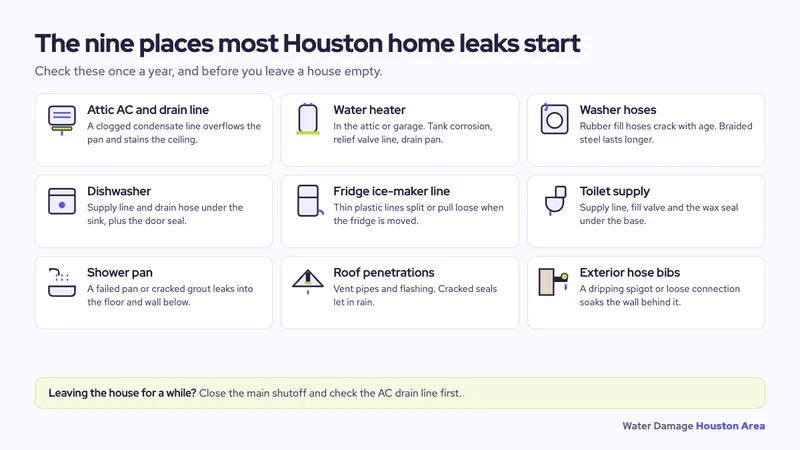
Water pouring from the tank body is an emergency, a dripping fitting is urgent, and a wet relief valve line calls for a plumber to find the reason. Plenty of Houston water heaters stand in an attic or garage, so the leak can reach a ceiling or shared wall unseen.
- Tank leak: the tank has failed. Close the cold inlet valve on top, then cut the fuel: turn a gas control to pilot or off, or switch an electric unit off at its breaker.
- Fitting or drain valve leak: close the cold inlet valve and call a plumber. Often the fitting can be fixed and the tank kept.
- Water from the relief valve or its discharge pipe: never cap or plug it, because it is a safety device.
Never leave the heater powered with the water shut off. The water heater leak page covers attic tanks, drain pans and relief valves in more detail.
What causes washing machine overflow and leaks?
The usual culprits are the fill hoses, the drain hose and the pump, and the worst floods begin when a hose gives way. A blocked standpipe can also back up and spill over its top, which is the other common overflow route.
A burst fill hose pours until the wall valves are shut. Closing both whenever you will be away for a while takes the worst case off the table.
Washer drain water and overflow are generally handled as Category 2. It runs under the machine and along baseboards, and in a two-story house it may come through the ceiling below. Raise the machine's feet off wet flooring, but never drag a full washer across it.
What happens when a dishwasher leaks under the cabinets?
Water heads downward rather than outward. It pools beneath the unit and soaks the cabinet base and the flooring under it, frequently before a puddle appears on the kitchen floor. A slow dishwasher leak can go on for weeks with no visible sign.
Likely sources are the door seal, the supply line and the drain hose under the sink. Remove the kick plate and look for stains, soft wood or a swollen cabinet floor.
Flooring under cabinets cannot be dried from the top. A restoration provider can measure moisture in the cabinet bases and floor and say what can dry in place. Fix the dishwasher first, or the leak starts over.
How do refrigerator and ice maker line leaks spread?
Slowly and out of view. A thin tube behind the fridge feeds the ice maker and water dispenser, and a pinhole or loose fitting can drip into the wall, the neighboring cabinet or the flooring for weeks before anyone notices.
People often find the leak only when a plank lifts, a floor cups or a baseboard turns soft. By then the wet area is bigger than the visible stain.
- Shut the small valve on the line and keep the ice maker off.
- Ease the fridge out and inspect the floor, the base of the wall and the line.
- Check both sides of the fridge, not just the front.
Water from a supply line is Category 1 at the start, but water that sits can pick up contamination from the materials it soaks. Drying sooner beats waiting to see how bad it gets.
Can a water softener leak cause water damage?
Yes. A softener has inlet and outlet connections, a drain line and a brine tank, and any of them can leak or overflow. Softeners often sit in a garage, a utility closet or beside the water heater, so the water reaches walls and flooring that nobody checks.
If you see water around the unit, move its bypass valve to bypass or close the house shutoff, then unplug the unit only if the floor around the outlet is dry. A plumber or the softener dealer should find the source.
Ask the restoration provider to look at the wall behind the unit and the flooring around it. Water that wicks up drywall can stay hidden for a long time.
What about AC condensate leaks from an attic air handler?
When the condensate drain clogs, the pan overflows and the water drops directly into the ceiling beneath it. Many Houston air handlers are in the attic, so nobody sees the leak until a stain or sag shows on the ceiling.
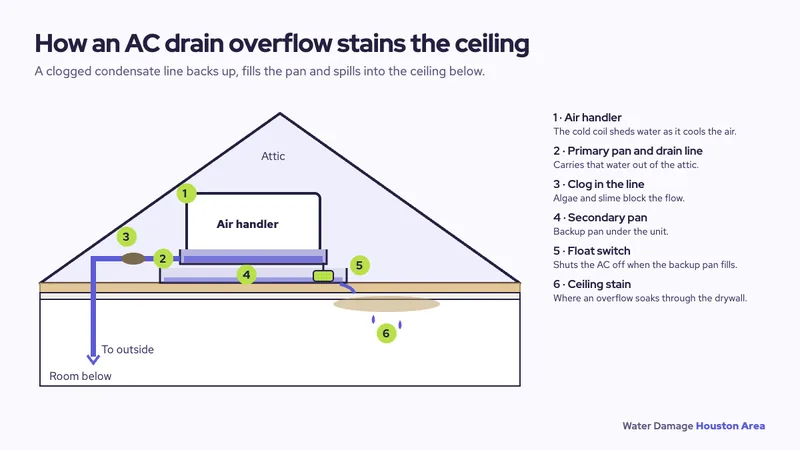
Turn the system off at the thermostat so it stops producing water. An HVAC technician then clears the drain and inspects the pan. The AC leak page covers pans and float switches, and the ceiling water damage page explains what to do about a bulging ceiling.
What are the signs of hidden appliance leak damage?
Look for swollen cabinet bottoms, floors that cup or lift, a musty smell, and stains or soft spots around an appliance. With a slow leak behind a fridge or beneath a dishwasher, the surrounding materials show damage before any water does.
- Soft or puffy cabinet bases below a sink or next to a dishwasher.
- Floorboards that cup, buckle or lift close to the kitchen or laundry.
- A musty smell that returns after cleaning.
- Bubbling paint or baseboards that have pulled away from the wall.
- A climbing water bill when your usage has not changed.
Only a moisture meter can confirm what the eye misses. The EPA advises drying water-damaged areas and items within 24 to 48 hours to prevent mold growth. Read signs of water damage and moisture meter readings for what the numbers mean.
Do leak sensors and automatic shutoff valves work?
They can limit the damage by alerting you or closing the water, but they only help where you put them and only if they are kept up. A sensor on the floor beside the water heater, washer, dishwasher or fridge tells you about a leak while it is still small.
- Leak sensors sit on the floor where water would land. Some sound an alarm; some send an alert to your phone.
- Automatic shutoff valves close the supply when a sensor trips. A plumber can tell you what fits your plumbing.
- Batteries and Wi-Fi need checking. A sensor with a dead battery protects nothing.
None of these replace looking at hoses and fittings. Check them for bulges, rust and drips on a schedule.
Does insurance cover an appliance leak?
Frequently, when the leak was sudden. Triple-I names accidental discharge or overflow of water from plumbing, heating, air conditioning or a household appliance as a covered peril on standard forms. The policy wording has the last word, so read it or ask your agent before counting on payment.
That source also says policies exclude damage from lack of maintenance, so a hose cracked for months or a leak that ran slowly for a long time is more likely to be denied. The NAIC adds that water damage from a home's plumbing is typically covered, while ground water and rain runoff are not.
Triple-I advises contacting your agent immediately, protecting the property, keeping receipts and holding on to damaged items until the adjuster visits. The Texas Department of Insurance lists the deadlines an insurer must meet and says a rejection must be explained in writing. The insurance claims guide covers the full process. If the plumber removes the failed part, hold on to it.
According to the Insurance Information Institute, roughly one in 60 insured homes files a property damage claim for water damage or freezing each year, and the average claim for 2019 to 2023 was $15,400.
How do I prevent the next appliance leak?
Make every shutoff easy to reach, put a sensor where water would land, and look at hoses and lines on a schedule. None of it costs much compared with the cleanup, and the prevention guide has a longer list. Small habits, repeated, catch most failures early.
- Test each shutoff once a year and clear anything stacked in front of it.
- Look at hoses and supply lines for bulges, rust at the fittings, cracks and drips. Ask a plumber about braided steel lines.
- Use a drain pan under a water heater that sits above finished space.
- Close the washer valves and the house shutoff when the house will be empty.
- Know where the main shutoff is. The cost guide shows why a fast shutoff matters.
If a leak has already soaked flooring or walls, see water mitigation for how drying is planned and checked.
Sources: IICRC, S500 standard; Triple-I, Which disasters are covered by homeowners insurance; Triple-I, Settling insurance claims after a disaster; Insurance Information Institute, Facts and statistics on homeowners and renters insurance; NAIC, Homeowners Insurance; Texas Department of Insurance, Getting your insurance claim paid; EPA, Brief Guide to Mold, Moisture and Your Home; CDC, About Mold and Your Health.