The short version
Nationally, Fixr (2025) puts water damage restoration at an average near $3,000, within a $1,200 to $5,000 range. The price climbs with dirtier water, a bigger wet area, more soaked materials and extra drying days. Houston quotes vary, so request written bids itemizing materials and prices.
How much does water damage restoration cost?
Nationally, Fixr lists water damage restoration at $1,200 to $5,000, with an average of $3,000. Bob Vila, citing Angi and HomeAdvisor, gives $1,305 to $5,707 and an average of $3,455. Neither range reflects Houston-specific conditions or any single home.
Treat these as national benchmarks, not Houston prices and not quotes. Independent providers set their own rates, and this site neither sets nor promises any. The numbers help you judge whether a bid looks sensible for the work it describes.
The spread is wide because "water damage" can mean a damp bathroom floor or a flooded living room. Total cost responds most to three things: what kind of water it was, how large the wet area is, and which materials got soaked.
How much does water extraction cost per square foot?
Fixr's national data puts extraction between $3.75 and $7.50 per square foot, with the price rising as the water gets dirtier. Protective gear, disposal and extra removal explain the climb. Houston bids can differ from these national numbers, so read them as a reference point rather than a price.
The IICRC S500 standard defines three water categories. A category measures contamination, not volume.
| Water category (IICRC S500) | Typical source | Extraction per sq ft (Fixr, national) |
|---|---|---|
| Category 1, clean | Supply line, burst pipe | $3.75 to $4.25 |
| Category 2, gray | Washer, dishwasher, toilet overflow without waste | $4.10 to $6.50 |
| Category 3, black | Sewage, rising river or stream water, outside surface water | $7 to $7.50 |
National figures from Fixr (2025). Houston bids vary.
A clean-water supply break sits at the cheap end. Where sewage is involved, the EPA advises hiring a professional with experience in contaminated water. The sewage backup cleanup and water removal pages describe how that work proceeds.
What is the difference between a water category and a damage class?
Category answers "how dirty is the water," while class answers "how much got wet." A burst supply line produces Category 1 water if it wets one room or three. The two measures vary independently, and each one shifts the price you are quoted.
Fixr lists flat ranges for Class 1 through 3. A higher class simply means the water traveled farther and more material absorbed it.
| Damage class | Flat cost range (Fixr, national) |
|---|---|
| Class 1 | $150 to $400 |
| Class 2 | $500 to $1,000 |
| Class 3 | $1,000 to $3,000 |
National figures from Fixr (2025). These are flat ranges, not per square foot.
Moving from Class 1 to Class 3 mostly adds wet material, drying equipment and drying days. Shutting off the source early is the best way to keep a job in a lower class.
What drives the cost of water damage repair in Houston?
Seven factors shape the bill, and most of them are set during the very first day of the loss. Providers weight them differently, so ask which ones explain your quote. Water that touches more rooms and more material almost always costs more.
- Water category. The earlier table shows clean, gray and black water carrying different rates.
- Spread. Water that enters a neighboring room or runs down inside a wall enlarges the area to dry.
- Area. The national data quotes both extraction and restoration per square foot.
- Removed materials. Pad, drywall and trim too far gone to save get torn out and replaced, a cost apart from drying.
- Equipment and duration. Dehumidifiers and air movers stay running until readings show the materials are dry.
- Contents. Furniture, boxes and electronics in the wet zone have to be relocated or handled.
- Access. A leak inside an attic or behind a finished wall takes more effort than an open room. If the leak comes from an attic air handler or water heater, see AC leak water damage.
How much does restoration cost by material?
Per square foot, Fixr's national figures make drywall the least expensive material to restore, with plaster and hardwood at the top. Carpeting and mold work land in the middle. A Houston bid may come in above or below these ranges, so use the table only as a rough guide.
| Material | Restoration per sq ft (Fixr, national) |
|---|---|
| Drywall | $1.50 to $3 |
| Carpeting | $4.75 to $10.50 |
| Plaster | $6.25 to $18.75 |
| Hardwood | $10 to $15 |
| Mold | $4.75 to $5.50 |
National figures from Fixr (2025).
Bob Vila prices a few jobs by area instead. Its national figures are $350 to $1,250 for ceiling repair, $1.50 to $3 per square foot for drywall repair and $200 to $500 to restore floors. The two sources agree on drywall, though they are separate surveys and other lines will not match.
How much does flood cleanup cost?
No source on this page gives a flood cleanup total, because floods vary too much. What the national data does show is that flood water from outside is Category 3, which Fixr prices at $7 to $7.50 per square foot for extraction alone. Removal and rebuild come on top.
The IICRC S500 lists rising river or stream water and outside surface water as Category 3. In Houston that covers bayou overflow and street flooding. Materials that wicked up dirty water, such as drywall and insulation, are often removed instead of dried.
Read flood cleanup for the process, and why Houston floods for the background. Flood is usually not paid by a standard homeowners policy, which the insurance section below covers.
What does it cost by type of damage?
Every kind of loss lands somewhere different in the national numbers above. The list maps common Houston causes onto figures already quoted, so none of it is a price for your home or any provider's quote. Use it to see which line of the national data applies to your situation.
- Burst or frozen pipe. Typically Category 1 water, so extraction follows Fixr's clean-water rate, with drying and any opened walls added. Fixing the pipe itself is the plumber's bill. See burst pipe water damage.
- Ceiling damage. Bob Vila lists ceiling repair at $350 to $1,250. Whatever leaked above, a roof or a pipe, gets repaired on its own. See ceiling water damage repair.
- Sewage backup. This is Category 3, which puts Fixr's extraction rate of $7 to $7.50 per square foot at the base of the estimate.
- Mold. Fixr lists $4.75 to $5.50 per square foot, and Bob Vila puts removal at $1,100 to $3,400 with a $2,200 average. See mold after water damage.
Of these, mold is the expense you can often dodge. To prevent growth, the EPA says water-damaged areas and items should be dried in the first 24 to 48 hours.
Why are mitigation and rebuild billed separately?
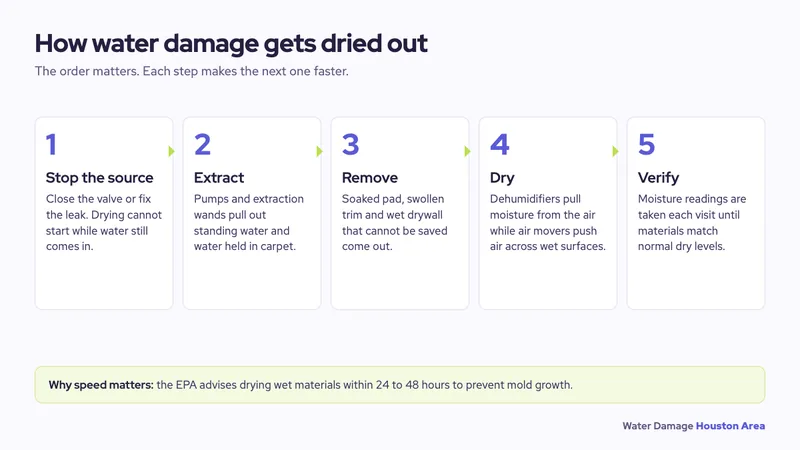
The two are separate jobs that often involve different companies and different timelines. Mitigation keeps the damage from growing: extraction, tearing out what cannot be saved, and drying. Rebuild restores the house with new drywall, paint, flooring and trim, and it usually comes later.
Mitigation goes first and wraps up once moisture readings show dry materials. Rebuild follows, and plenty of homeowners hire a different contractor for it. Ask whether a quote spans one phase or both. The water mitigation page covers the first phase.
A cheap mitigation quote with no rebuild line is neither a deal nor a trap on its own. It just means the quote covers half the work.
How do I read a water damage estimate?
Read it one line at a time and check four items: equipment days, square footage, materials removed and documentation. A clear estimate shows what each dollar pays for. When a line does not make sense, get the provider to explain it before you sign.
- Equipment and days. Every dehumidifier and air mover should list the days it ran.
- Square footage. Extraction and removal lines need the area and the rate stated.
- Materials removed. Pad, drywall, baseboard and insulation belong on separate lines, not in one lump.
- Photos and readings. Ask for the photos and moisture readings behind the drying days.
- Rebuild items. Confirm which lines are mitigation and which are replacement.
Providers write estimates differently, so confirm the details directly. The mitigation invoice explained page walks through a typical invoice, and the glossary defines common terms.
Can I get a free estimate or a price over the phone?
Whether an estimate is free depends on the provider, so ask before anyone makes the trip. A firm phone price is uncommon because the provider normally has to see the damage and take readings. Treat a fixed total quoted sight unseen with suspicion.
The Insurance Information Institute (Triple-I) recommends written bids that list materials and prices line by line, which lets you compare companies fairly.
Line up the same rooms, materials and drying days across bids. If one is far lower, find out what it leaves out, and if one is far higher, ask what it adds. Do not let water sit while you wait for bids. Stop the source and start extraction first, then compare the less urgent rebuild quotes. The choosing a restoration company guide has questions to ask.
What does insurance pay toward water damage restoration?
The cause and your policy decide. Sudden plumbing and appliance leaks are often covered, but flood and sewer backup usually need separate coverage. Weigh the repair estimate against your deductible before choosing whether to file, and put the question to your insurer or agent.
- Often covered: accidental discharge or overflow from plumbing, air conditioning or a household appliance, plus freezing of those systems (Triple-I). The NAIC says a roof leak is typically covered as well.
- Not covered by standard policies: flood. FEMA says most homeowners insurance does not cover flooding.
- Usually an add-on: sewer backup. Mold and lack of maintenance are often excluded.
For scale, the Triple-I fact sheet puts the average water damage and freezing claim at $15,400 (2019 to 2023). After Winter Storm Uri, the Texas Department of Insurance reported an average incurred loss of about $17,800 on residential property policies statewide. Your claim depends on your own damage and policy. The insurance claims guide covers the process.
How can I keep the cost down?
Shut off the water quickly, then dry wet materials in the first 24 to 48 hours, the window the EPA gives for preventing mold. Most savings come from the first day, which makes the order of your first moves important.
- Stop the source. Close the main shutoff or the closest valve, because water that keeps flowing pushes the job into a higher class.
- Clear contents from the wet zone when it is safe, so furniture and boxes stop absorbing water.
- Call early. A restoration provider can begin extraction and drying while you deal with the plumber and the insurer.
- Record everything. Keep photos, video and receipts, and hold damaged items until the adjuster visits, as Triple-I advises.
- Lower the humidity. The EPA suggests keeping indoor humidity under 60 percent, ideally between 30 and 50 percent.
The contact page is how to reach a provider. They differ, so confirm details directly.
Sources: Fixr, Water Damage Restoration Cost (updated January 31, 2025); Bob Vila, How Much Does Water Damage Restoration Cost? (updated May 30, 2023); IICRC S500; Triple-I, Homeowners and renters insurance facts; Triple-I, Settling insurance claims after a disaster; Triple-I, Which disasters are covered by homeowners insurance?; NAIC, Homeowners Insurance; FEMA, Don't have flood insurance; EPA, A Brief Guide to Mold, Moisture and Your Home; EPA, Mold cleanup in your home; TDI, Winter Storm Uri losses report.