The short version
Structural drying in Houston uses air movers, dehumidifiers and moisture readings to remove water from walls, floors and framing. The EPA advises starting in the first 24 to 48 hours and keeping indoor humidity below 60 percent. The readings decide when it ends. Ask for the dry log.
What is structural drying, and how does it work?
Structural drying is the planned removal of moisture from a building's materials after water gets in. Air movers push dry air across wet surfaces, dehumidifiers pull moisture out of the air, and meter readings show progress. In Houston, structural drying is the stage that decides whether a wet house stays sound.
It is one phase of water mitigation. Extraction comes first, as covered on the water removal page, because pumping or vacuuming standing water is faster than evaporating it. Drying handles what soaks into drywall, framing, subfloor, cabinets and flooring.
This site is a referral service, not a contractor. It connects property owners with independent restoration providers. Providers differ in equipment, method and scope, so confirm directly what each one will do at your address.
What equipment is used to dry a water-damaged house?
Three kinds of machines do most of the work: air movers, dehumidifiers and air scrubbers. They are used together as one system, and each has a separate job. Providers pick the brands and the number of units, so ask what will be placed in each room and why.
| Equipment | What it does | What to ask |
|---|---|---|
| Air mover | Blows air across wet surfaces so water evaporates faster | Where will each one be aimed? |
| Dehumidifier | Collects the vapor that air movers release, so it does not settle on cool walls | Is the room sealed so it can work? |
| Air scrubber | Filters dust and particles from the air, mainly when walls are opened | Is it needed for this job? |
| Moisture meter | Reads moisture in drywall, wood and subfloor at marked spots | Will I get the readings each visit? |
| Thermal camera | Shows cool, damp patches behind a surface so meters can check them | Are camera images backed by meter numbers? |
A fan from a hardware store moves air but removes no water from the building. Fans without dehumidification can push damp air into other rooms. For the vocabulary on a work authorization, see the water damage glossary.

How long does structural drying take in Houston?
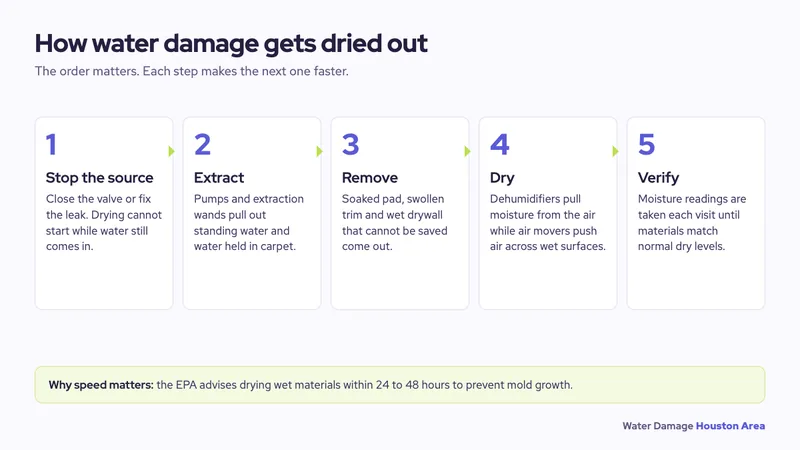
Drying usually takes a few days, and the readings decide the end date, not the calendar. Dense materials such as framing, subfloor and concrete release water slowly. The EPA advises drying water-damaged areas and items in the first 24 to 48 hours to prevent mold growth.
That 24 to 48 hour window is for starting and for getting surfaces dry. Deep materials can take longer, and a provider can only estimate until the first set of readings is in.
Several things change the timeline:
- How long the materials stayed wet before anyone started.
- The water category. Contaminated water means more materials are removed, not dried.
- The material. Drywall and carpet dry faster than hardwood, plaster or a slab.
- Hidden water. Wet insulation or a wet wall plate behind an intact wall slows everything.
- Access. Cabinets, built-ins and tile can trap water against the wall behind them.
Treat any promised number of days as an estimate. A provider that says the job is finished without showing readings has not shown you anything.
Does Houston humidity make drying harder?
It can, because drying works by moving water into the air and then removing it from the air. Outdoor air on a muggy day can add water to a wet room instead of removing it. That is why drying depends on dehumidifiers more than on open windows, and why providers usually keep the drying area closed.
The National Weather Service lists a 1991-2020 average July high of 94.5 F at Bush Intercontinental, and a mean July temperature of 85.1 F. Warm, damp air is the normal summer condition, so do not count on a breeze through the house to finish the job.
In cooler months, a closed house with the air conditioner or heat running is still the usual setup. Ask the provider whether your thermostat should stay on, and at what setting. Dry air in a closed room is the aim, whatever the season.
The EPA says to keep indoor humidity below 60 percent, ideally between 30 and 50 percent. Ask what humidity reading the provider expects in the drying room, and check it against that range.
How do you dry a concrete slab or wet subfloor?
A slab dries from the top, slowly, and the surface can read dry while the concrete below is still damp. Subfloor over a crawl space or pier-and-beam floor dries from both sides when the cavity below can be reached. Either way, flooring goes back only after readings confirm the base is dry.
If your house sits on a slab, water spreads across the floor and wicks into the bottom of walls. Water that gets under flooring can sit against the slab. Drying then means lifting or removing the covering so dry air reaches the surface.
Different floors behave in different ways:
- Carpet and pad: the pad is usually removed. Carpet may be lifted and dried, or discarded. See wet carpet drying.
- Hardwood and engineered wood: boards swell and cup. Some flatten as they dry, and some do not. See water damaged floor repair.
- Tile over a slab: the tile itself is fine, but water can sit in the grout, the thin-set and the slab beneath.
- Vinyl and laminate: water often runs under the planks. They usually have to come up so the base can dry.
Water from a leak under the slab is a plumbing problem first. See slab leak water damage before drying anything, because a leak that is still running keeps the slab wet.
How do I know when structural drying is finished?
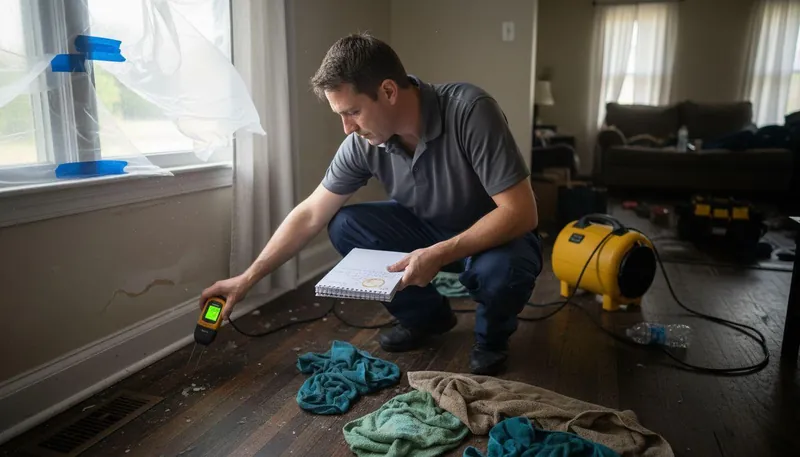
Drying is finished when the moisture readings in each material match a dry reference, usually an unaffected area of the same material in your home. Look at the numbers, not the machines. A dry log with dated readings at marked points is the proof you can keep.
A good log lists the room, the material, the reading and the date for each visit. It also shows the air conditions in the drying room and the equipment on site. If the numbers stop dropping, the provider should look for a hidden source of water, a wet cavity or a trapped pocket.
The moisture meter readings page explains how to read the numbers. The mitigation invoice guide shows how equipment days and monitoring visits appear on a bill.
Do not accept an end to the job just because the room feels dry or the machines were removed. Ask what reading ended the job, and ask for a copy of the log.
What should I do first when a room needs drying?
Stop the water, make the area safe and document the damage. Drying can only begin once the source is controlled and the electrical hazards are dealt with. These steps cost nothing, they protect your insurance claim, and they make the work of any provider you hire much easier.
- Stop the source. Shut the main water valve for a plumbing leak, or turn off the air conditioner for a condensate overflow. The emergency water damage page covers the first hour.
- Make it safe. If water is near outlets, appliances or the panel, turn off power to that area only if you can reach the breaker without standing in water. Otherwise call an electrician.
- Photograph and video everything before anything is moved, as Triple-I advises for claims.
- Remove what you safely can: loose rugs, wet furniture legs, books and boxes on the floor.
- Keep the air conditioning running unless the unit or its ducts got wet.
- Request a connection with a restoration provider, and ask about equipment, readings and the dry log.
Do not sweep it under the rug and wait. The CDC says to clean up and dry out a flooded home fully and quickly, within 24 to 48 hours.
What is it like to live in a house during structural drying?
Expect noise, heat and a high power draw for several days. Air movers and dehumidifiers run all day and night, and the dehumidifiers add warm air to a closed room. Many people sleep elsewhere, especially when the drying area is next to a bedroom.
- Noise: ask where units will go, and whether any can be placed away from bedrooms.
- Electricity: equipment needs outlets, and several units can trip a breaker. Ask about circuits before it starts.
- Pets and children: keep both away from cords, blowing air and open wall cavities.
- Do not move or unplug machines. A relocated unit can leave a wet area untouched.
If the water was contaminated, read is it safe to stay in the house. The CDC says that people with asthma or mold allergy can have severe reactions to mold, and that people with weakened immune systems or chronic lung disease can get lung infections.
Does insurance pay for structural drying?
Often yes, when the cause is a covered source such as a sudden plumbing failure. The NAIC says water damage from a home's plumbing or a roof leak is typically covered, and damage from ground water or rain runoff is not. Your policy and your adjuster decide, not the provider.
Triple-I advises taking reasonable steps to protect your property and keeping receipts for what you spend. Drying is a reasonable protective step. Permanent repairs should wait until the adjuster has assessed the damage.
Flood is different. The Triple-I says flood damage is excluded under standard homeowners and renters policies, and FEMA says most homeowners insurance does not cover flooding. Rising water from a bayou or street is covered only by a separate flood policy.
Read water damage insurance claims in Houston for the claim steps and the Texas Department of Insurance deadlines for insurers.
What are the signs that drying stopped too early?
A returning smell, a spot that stays damp or a reading that climbs again means drying is unfinished. A musty odor that comes back after the machines leave is the most common sign. Warped floors, bubbling paint and soft baseboards are others.
- A musty or sour smell that returns, especially after rain or when the air is humid.
- Baseboards, cabinet bases or drywall that feel soft, cool or damp.
- Floors that cup, buckle or lift after being installed over a damp base.
- Dark spots on walls or ceilings. The mold after water damage guide explains what to do.
- Indoor humidity that stays above the EPA's 60 percent limit.
If you see these, ask the provider to re-check readings before anything is closed up. The EPA says not to paint or caulk moldy surfaces. Once walls are dry and confirmed, rebuilding is covered on water damage repair.
Not sure which providers cover your ZIP code? See the service areas or request a connection.
Sources: EPA, A Brief Guide to Mold, Moisture and Your Home; EPA, Mold Cleanup in Your Home; CDC, About Mold and Your Health; NWS Houston/Galveston, IAH normals; NAIC, Homeowners Insurance; Triple-I, Settling insurance claims after a disaster; Triple-I, Which disasters are covered by homeowners insurance?; FEMA, Don't have flood insurance.