The short version
For wood floor water damage repair in Houston, stop the water, remove what is standing and begin drying quickly. Clean-water hardwood can often be saved if the subfloor dries too, laminate usually cannot, and flood water means replacement. The EPA advises getting things dry in the first 24 to 48 hours.
What should I do first when a wood floor gets wet?
Stop the water, clear what is standing on the floor and get air moving. Wood floor water damage repair in Houston starts in the first day or two, because boards and the subfloor under them stay wet long after the surface looks dry.
- Stop the source. Close the main shutoff or the fixture stop, or have a plumber fix the leak. Nothing dries while water keeps arriving.
- Turn off the breaker for wet rooms, provided you can get to the panel without stepping in water.
- Lift rugs, mats and furniture that hold water against the boards, and rest wood legs on foil or plastic.
- Take photos of the floor before touching it, including gaps, raised edges and stains.
- Run fans and a dehumidifier. Do not aim a space heater at the boards, since fast heat can crack and warp them.
- Phone your insurer and a restoration provider. The EPA advises getting water-damaged areas and items dry in the first 24 to 48 hours to prevent mold growth.
Never sand, seal or refinish a floor that may still be wet. If a supply line failed, the shutoff steps are on the burst pipe page, and the full drying process is described under water damage repair.
How does each type of flooring react to water?
Every material fails differently, and flooring type is the biggest factor in whether a floor can be saved. Solid wood often dries out when action is quick, and laminate is the hardest to save. Tile handles water well, but what lies beneath it may not.
| Flooring | Reaction to water | Usually dryable? | Signs it has to be replaced |
|---|---|---|---|
| Solid hardwood | Boards swell and cup, then can crown or buckle | Often, if caught early and the subfloor dries too | Buckled boards, black staining, a musty smell that stays |
| Engineered wood | Layers can swell and separate; the wear layer can lift | Sometimes, after a light wetting | Delaminated layers, bubbling, edges that will not lie flat |
| Laminate | The fiberboard core swells at the seams and stays swollen | Rarely once the core is soaked | Peaked or crumbling seams, planks that no longer click |
| Vinyl plank and sheet vinyl | The vinyl resists water, but seams and edges let it in | The plank often can; the subfloor is the concern | Curling edges, trapped water, odor, a wet subfloor |
| Tile | Tile and grout hold up; water passes through grout lines | The tile usually can; the layers below need a check | Hollow-sounding tiles, cracked grout, a damp or soft base |
Read the table as a rough guide rather than a ruling on your own floor. Before anyone decides what stays, a restoration provider measures moisture in the flooring and the subfloor. Carpet is covered under wet carpet drying.
What do cupping, crowning and buckling mean?
Cupping, crowning and buckling are three stages of wood responding to moisture, and each one hints at where the water came from. Cupped boards have edges higher than the center, and crowning is the opposite. Buckling is the worst stage, with boards lifting off the subfloor.
- Cupping: the underside took on more moisture than the top. It is the classic sign of water from below, such as a slow plumbing leak or damp slab.
- Crowning: the top absorbed more moisture, or a cupped floor was sanded before it finished drying and then flattened out as it dried.
- Buckling: the floor swelled enough that boards push up and away, sometimes in a ridge. It usually follows a lot of water or a long wetting.
Gentle, even drying can ease mild cupping over time. Boards that have buckled seldom go flat again. Hold off on any permanent decision until the readings are dry.
Can hardwood floors be saved after water damage?
Frequently, provided the water was clean, drying began quickly and the subfloor can dry too. Hardwood is dense, so it absorbs water slowly and releases it slowly, which gives you a window to act, and the faster it dries, the better the odds of keeping it.
The outlook worsens if water sat for days, carried contamination, or crept up from below over several weeks. Dark staining, a lingering musty odor and boards that have pulled off the subfloor all point toward replacement. A provider can measure moisture in the boards to show which case you have; providers differ, so ask whether they dry wood floors in place.
Can I dry a wood floor myself?
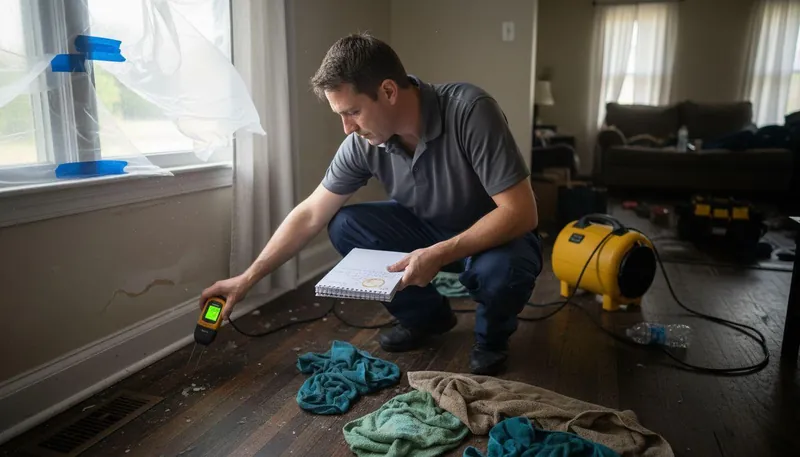
A small clean spill that you catch at once is something you can handle. Mop or vacuum up the water, set fans and a dehumidifier going, and keep an eye on whether the boards stay flat. Anything bigger takes professional equipment and moisture readings, not guesswork or a box fan.
Providers commonly use drying mats or panels that draw moisture out of the surface, along with dehumidifiers and air movers. They log readings on the boards and subfloor and keep going until the numbers return to normal for the home. Surfaces can feel dry while the layers below stay wet, so readings are more reliable than touch.
Drying does not always mean pulling up the floor. Sometimes a few boards come out along a wall so air can reach the subfloor. The structural drying page covers the equipment, and moisture meter readings explains the numbers.
What about laminate floors after a leak?
After a real soaking, laminate is the floor most likely to be replaced. Its core is compressed fiberboard, and once that core swells at the seams it will not shrink again. A quickly wiped spill may do no harm, but water that gets into the seams usually does.
Look for raised seams, crumbling edges and planks that no longer lock together. If only a few boards are hurt and the rest lie flat, those boards can sometimes be swapped. Laminate floats on an underlayment, so check under it for water held against the subfloor.
What about vinyl plank and tile on a Houston slab?
The surface usually survives; the layer beneath is the worry. Water does not hurt vinyl plank or tile, but what slips through seams or grout can collect on the base below, and that is where damage and mold begin, often unseen.
- Vinyl plank and sheet vinyl: curling edges, trapped water, odor or a soft base usually mean the flooring comes up so the base can dry.
- Tile: a hollow ring when you tap a tile, cracked grout, or a soft bed underneath suggest the layer below got wet.
If a floor looks fine yet feels spongy or smells musty, trust a moisture reading over your eyes. The water damage smell page helps when odor is the main clue.
Can moisture come up through a concrete slab under my floor?
Yes. If your house sits on a slab, a leaking pipe in or under it, or water that soaked in from outside, can wet the flooring from below. The signs are cupping with no spill above, a warm patch or a floor that stays damp for no clear reason.
Concrete holds moisture and releases it slowly, so a slab under flooring may need days of drying with dehumidifiers before new flooring goes down. Installing over a damp slab can trap moisture again. Ask any provider and any flooring installer how they confirm the slab is dry first.
A floor that keeps cupping after the surface is dry may point to a pipe problem. See slab leak water damage for the warning signs and the meter test.
Can water get trapped in the subfloor or under the flooring?
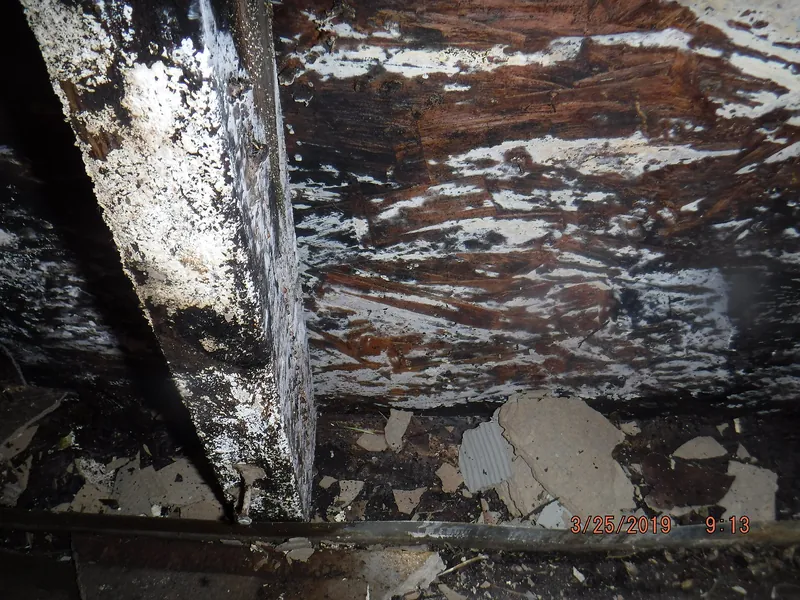
Yes, and it is a common reason floors fail weeks later. Water works its way under the flooring through seams and along walls, then stays between layers where air cannot get to it. Dry-looking flooring can hide a wet layer underneath.
Warning signs include a soft or spongy feel, boards that begin to cup after the surface has dried, an odor you cannot trace, and baseboards that stay damp. Plywood and OSB lose strength and swell if they stay wet. To reach that layer, a provider may lift a few boards, drill small holes or use specialty drying equipment.

Leaks from wet rooms are a common source. The bathroom and kitchen water damage page shows where they hide.
What if flood water from a storm reached the floor?
Treat it as contaminated and plan on removing porous flooring. Under the IICRC S500 standard, rising flood water from rivers, streams and outside surface water is Category 3, grossly contaminated. Wood, laminate and anything with a pad underneath that touched it usually cannot be cleaned to a safe level.
The National Hurricane Center reports that at least 160,000 structures flooded in Harris and Galveston counties during Hurricane Harvey. For contaminated-water damage, the EPA recommends bringing in a professional with experience in it.
Put on rubber boots and gloves, and keep kids and pets away from the area. Flood is excluded from standard homeowners policies, so read the flood cleanup page and the insurance claims guide before you throw anything out.
When should a floor be replaced instead of dried?
Replace a floor when the material cannot settle back into a stable, flat shape, or when the water carried contamination. Drying earns a try when the water was clean, work began quickly, and the floor is solid wood or something else that copes with moisture.
| Situation | Usual call |
|---|---|
| Clean water, quick response, solid hardwood | Try drying, then check flatness |
| Long dampness from below, with black staining | Expect replacement and a subfloor check |
| Laminate whose seams have swollen | Replace the damaged area |
| Floor touched by sewage or flood water | Porous flooring comes out; see sewage backup cleanup |
Some dried floors can be sanded and refinished, but only after readings confirm the wood is dry. Refinishing early is how crowning and trapped moisture begin.
How much does wood floor water damage repair cost?
What you pay varies with the flooring, the square footage and whether the subfloor is affected. Fixr's national figure for hardwood restoration is $10 to $15 per square foot, while Bob Vila reports $200 to $500 to restore floors, citing Angi and HomeAdvisor data. Neither is a Houston quote.
That gap shows how wide the range is, since a small drying job and a full tear-out are very different bills. Get written bids that itemize materials and labor, because providers set their own prices and nothing here is a quote. The restoration cost page explains how bills are built.
Does homeowners insurance cover water-damaged floors in Texas?
For Texas homeowners, the cause decides. Damage from a sudden, accidental event, like a burst pipe, is often covered. According to the Insurance Information Institute, policies will not cover damage from lack of maintenance, so a long unnoticed leak may be excluded.
Standard homeowners policies exclude flood damage, the Triple-I says, and FEMA adds that most homeowners insurance does not cover flooding. Triple-I advises photographing damage, saving receipts, and keeping damaged items until the adjuster visits.
Texas sets claim-handling deadlines. The Texas Department of Insurance says a company has 15 business days to acknowledge a claim. Read the insurance claims guide for the steps and a TDI complaint link.
Sources: EPA mold and moisture guide; EPA mold cleanup in your home; IICRC S500 standard; NHC Hurricane Harvey report; Fixr, Water Damage Restoration Cost; Bob Vila, Water Damage Restoration Cost; Triple-I, Which disasters are covered; Triple-I, Settling claims; FEMA flood insurance FAQ; TDI, Getting your claim paid.