For Conroe, Willis and Montgomery homeowners
For water damage restoration in Conroe, TX, shut off the main valve, photograph everything and start drying in the first 24 to 48 hours. Flood water is not covered by standard homeowners policies. We take requests from Conroe, Willis and Montgomery.
Which Conroe addresses do you take requests from?
For water damage restoration in Conroe, TX, requests come in from Conroe (77301, 77302, 77303, 77304 and 77306), Willis (77318 and 77378) and Montgomery (77316 and 77356). PO boxes in Conroe (77305) and Dobbin (77333) are also on the list. A restoration provider confirms they can reach your street when they call.
Conroe is the county seat of Montgomery County, and Wikipedia puts it about 40 miles north of Houston. Willis is eight miles north of Conroe, and Montgomery lies to the west on Lake Conroe, so one page covers all three. For the suburbs just south, see The Woodlands and Spring and Klein.
Does Conroe flood?
Parts of it do. Wikipedia says the West Fork of the San Jacinto River flows through the western edge of Conroe, that parts of the city around the river are in a floodplain, and that the whole city sits in the river's watershed. Homes outside the floodplain can still get wet from heavy rain.
The same article says significant flooding follows when rain tops 9 inches in 48 hours, which the Conroe area has about a 10% chance of seeing in any given year. It adds that Montgomery County had 500-year floods in May 2015, April 2016 and August 2017, plus a fourth major flood in May 2016.
Water that comes from outside the house is Category 3 under the IICRC S500 standard. Read flood cleanup before you touch it, and check how flood zone maps work for your address.
Can Lake Conroe releases flood homes downstream?
Wikipedia describes one case. During Hurricane Harvey in August 2017, nearly 32 inches of rain fell on Conroe, and San Jacinto River Authority officials released 79,100 cubic feet per second from Lake Conroe into the West Fork to protect the dam. The article says that worsened flooding already underway in the floodplain.
The city ordered a mandatory evacuation of McDade Estates, a neighborhood on the river bank. Wikipedia does not say how many homes took water, so no count is given here.
The lake itself was finished in 1973, and the same source says the City of Houston owns two-thirds of it and the river authority one-third. If your address lies along the river below the dam, ask the authority and your insurance agent what its records show for your street. Our hurricane water damage guide covers the first steps after a storm.
What should I ask before buying a lake house near Conroe?
Ask the seller what the state disclosure form says. Texas Senate Bill 339 added questions to the seller's disclosure notice about previous flooding from a failure or controlled release of a reservoir, and about previous water entering the house in a natural flood. Those answers are worth reading closely.
- Ask for the completed disclosure notice and read the flooding section line by line.
- Ask whether the seller carries flood insurance, since the same form asks about present coverage.
- Look for stains, soft trim and swollen baseboards near doors and low walls.
- Have a plumber and an inspector look, and ask them to take moisture readings.
Our guide to buying a flooded house and the home inspection page go further. Only the southern third of the lake is in the city of Conroe, according to Wikipedia, so many lake addresses are in unincorporated Montgomery County.
How did growth shape the houses in Conroe?
Conroe grew in waves. Isaac Conroe founded a sawmill there in 1881, an oil field was found in 1931, and I-45 later pulled Houston families north. The Census counted 36,811 residents in 2000, 56,207 in 2010 and 89,956 in 2020, so a large share of the homes are newer than the old downtown.
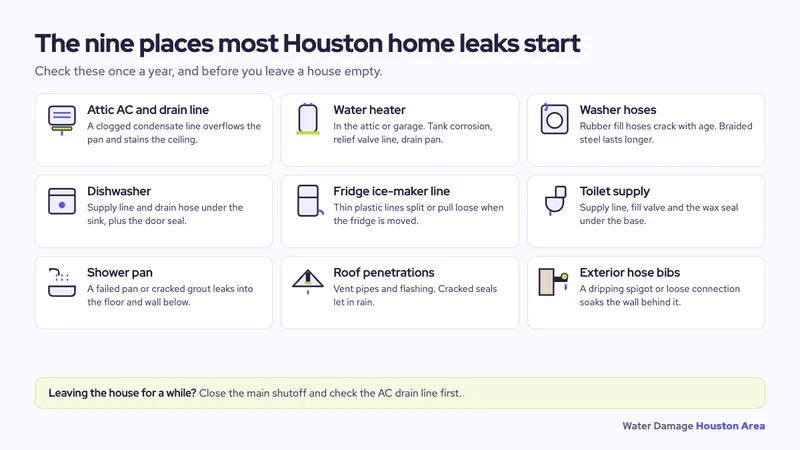
Wikipedia says new houses went up in large numbers between 2003 and 2006 and that the Census Bureau named Conroe the fastest-growing large US city from 2015 to 2016. If your water heater or air handler sits in the attic or garage, those are the first places to look after a ceiling stain.
| Place | 2020 Census housing units | Share vacant | Water note |
|---|---|---|---|
| Conroe | 36,938 | 9.2% | West Fork floodplain, new subdivisions |
| Willis | 2,346 | 8.0% | Railroad town a few miles from the lake |
| Montgomery | 914 | 12.0% | Next to Lake Conroe, small historic core |
Wikipedia also says 54.4% of occupied homes in Conroe are owner-occupied and 45.6% are rented. Tenants should read the renters and condo guide.
What is different about Willis and Montgomery?
Both are older towns with their own histories, and both are close to Lake Conroe. Willis began in 1870 when the Houston and Great Northern Railroad, now Union Pacific, came through. Montgomery was founded in 1837 and was the first county seat of the county.
Willis had 6,431 residents in 2020, and Wikipedia says Farm to Market Road 1097 links it to the lake and to Montgomery. Montgomery had 1,948 residents, and 21.4% lived in rural areas.
If your house is old, it may still have galvanized supply lines or an original roof. Read galvanized pipe leaks if the water pressure has dropped or the water runs brown. If trees shade your roof, damp shingles can stay wet longer after a storm.
How wet can a month get in Conroe?
Rain did. The National Weather Service Houston office reported 14.77 inches at Conroe in May 2024, the wettest May on record there. That is a monthly total, not one storm, but it shows how long wet spells can keep soil and roofs saturated.
After a month like that, look for slow leaks as well as obvious ones. Stained ceilings, musty rooms and warped trim can appear days later, and roof leak and storm water damage explains how to trace them. Take photos before repairs and save every receipt for the insurer.
Will insurance cover water damage in Conroe?
A sudden plumbing or roof leak is usually covered, but flood is not. The Insurance Information Institute says flood is excluded from standard homeowners and renters policies and needs a separate one. The NAIC adds that ground water and rain runoff are typically not covered either.
Sewer backups are a third case. Triple-I says a typical homeowners policy does not cover them, and flood insurance does not either, so ask your agent about an endorsement.
Living near Lake Conroe or the West Fork does not change those rules. Call your agent before you sign a work order, and read the insurance claims guide for what to photograph and keep.
What should I do in the first 24 to 48 hours?
Stop the water, protect people, then start drying. The EPA says to dry water-damaged areas and items within 24 to 48 hours to prevent mold growth, so the clock matters from the first hour. Water that is clean at first, such as a supply line, can turn into a mold problem once it sits in drywall, carpet pad and insulation.
- Shut off the main water valve, and the power to wet areas if you can do it safely.
- Photograph and video everything before you move it.
- Call your insurer and ask what they need before work starts.
- Call a restoration provider and ask what they will measure and how they will document drying.
- Keep indoor humidity below 60 percent, ideally 30 to 50, as the EPA recommends.
The emergency page has a longer checklist, and mold after water damage covers growth that has already started. Providers differ on where they drive, so confirm coverage when they call. Nearby guides: Tomball and New Caney and Porter.
Sources: Conroe, Texas; Lake Conroe; Willis, Texas; Montgomery, Texas (all Wikipedia, citing the 2020 Census); NWS Houston/Galveston, May 2024 Regional Climate Summary; Texas SB 339 (86th Legislature), seller's disclosure; EPA, A Brief Guide to Mold, Moisture and Your Home; IICRC S500; Triple-I, disasters covered by homeowners insurance; NAIC homeowners insurance; American Red Cross, frozen pipes.