The short version
For sewage cleanup in Houston, stop running water, keep children and pets away from the room and wear gloves and boots if you must touch anything wet. Sewage is Category 3 water, which means soaked carpet and drywall get removed and hard surfaces get disinfected. Coverage typically requires a sewer backup endorsement on your policy.
What should I do first when sewage backs up into my house?
Do not run any more water down the drains, and keep people away from the spill. Every flush, shower or laundry load adds pressure behind the blockage, and the lowest opening in the house is where it escapes. After that, phone a plumber and a restoration provider.
- Shut down all water use: flushing, faucets, baths, showers, the dishwasher and the washer.
- Move children and pets out of the room and shut the door when possible.
- Cut power to the room at the breaker, but only when you can reach the panel on dry ground. Otherwise stay out and call an electrician.
- Avoid contact with the water and wet items unless you have waterproof gloves and boots, and scrub your hands thoroughly afterward.
- Take photos of the backup and of the drain it rose from before anything shifts. Insurers ask for these.
- Check the cleanout near the street (see the responsibility section below), then call a plumber to clear the line.
After the line is clear, a restoration provider handles the cleanup. See water removal in Houston for how extraction works, and confirm directly what any provider will do and when.
Why does sewage come up through the lowest drain in a Houston house?
Because a backup has to go somewhere, and it takes the lowest opening it can find. In a house built on a concrete slab there is no lower level to fill, so the water rises through a shower, tub or floor drain on the ground floor, often the one nearest the sewer line.
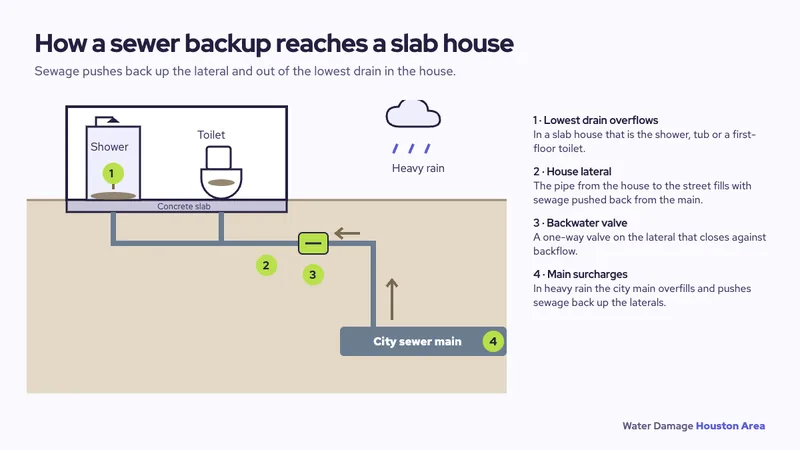
Three things usually cause it:
- A clog in your own line between the house and the street, from grease, wipes, tree roots or a damaged pipe.
- An overloaded city sewer main, which can happen when heavy rain puts more water into the system than it can carry.
- A clog inside the house, which normally affects one fixture instead of the lowest drain.
Is sewage Category 3 water, and why does that matter?
Yes. The IICRC S500 standard puts sewage in Category 3, the most contaminated class, along with rising flood water from rivers and streams. It carries bacteria and other pathogens, so porous materials it soaks into cannot be reliably cleaned and are normally removed.
The EPA advises that when damage comes from sewage or other contaminated water, you should call a professional who has handled buildings damaged by contaminated water. Mops, household cleaners and a wet vac alone will not do the job.
- Carpet, pad, soaked drywall, insulation and upholstered items come out and are discarded.
- Concrete, tile and sealed wood get cleaned and disinfected.
- Drying equipment goes in after cleaning, not before.
Outside flood water is also Category 3. See flood cleanup in Houston if the water came from the street or a bayou instead of a drain.
Is a toilet overflow the same as a sewage backup?
Not necessarily. Under IICRC S500, an overflow from a toilet with no waste in it is Category 2 grey water. Water carrying waste, or rising out of a drain, is Category 3. The category determines what can be dried and what has to be discarded.
| The situation | Category under IICRC S500 | Typical next steps |
|---|---|---|
| Toilet overflow without waste | Category 2, grey water | Clean, disinfect, dry. Ask the provider which items can be saved |
| Washer or dishwasher overflow | Category 2, grey water | Clean and dry, after checking which materials the water reached |
| Toilet overflow carrying waste | Category 3 | Porous materials are taken out and hard surfaces are disinfected |
| Sewage from a shower, tub or floor drain | Category 3 | Soaked porous materials go, and hard surfaces are disinfected |
When you cannot tell which kind it is, assume Category 3 and put on gloves and boots. The water damage glossary explains all three categories.
Who is responsible for a sewer backup: me or the City of Houston?
It depends on where the blockage sits. Houston Public Works says problems with private wastewater pipes, which are usually closer to the home, are the homeowner's responsibility. Problems with public pipes, or pipes in a public right-of-way, are the responsibility of Houston Public Works.
The city gives a simple test for a backed-up toilet. Check the cleanout at the street. If sewer water is standing by the pipe, call 311 or submit a 311 request. If there is no standing sewer water, the blockage is on your private line and you should call a plumber.
- Take a photo of the cleanout before you call, whatever you find.
- If neighbors have the same problem, mention it when you report it.
- Ask the plumber for a written note on where the blockage was. Your insurer and the city may both want it.
Does heavy rain cause sewer backups in Houston?
It can, but grease and wipes are the bigger everyday cause. Houston Public Works says 70% of sewer overflows in the city are caused by clogs from fats, oils and grease poured down drains and wipes flushed down toilets. It also says Houston has hundreds of sewer overflows each year.
Heavy rain adds a second risk. Storm water can get into the sewer system and overload the main, which pushes sewage back toward houses at the low end of the line. The page on why Houston floods explains why the region takes so much water at once.
If sewage and flood water arrive together, treat all of it as Category 3 and keep out until it is cleaned up. See when it is safe to stay in a house after water damage.
Who should stay away from a sewage backup?
Everyone with no reason to be close. Sewage carries bacteria and other pathogens, so keep these people and pets away until the area is cleaned and dry: people with a weak immune system or a lung condition, older adults, pregnant people, young children, and anyone with open cuts.
- Shut the door of the room to keep odor and spray from traveling.
- Going in is a last resort: put on eye protection, waterproof gloves and boots, and clean up afterward with soap and clean water.
- No eating, drinking or smoking in the affected area.
- See a doctor if anyone falls ill following exposure, or if a cut was exposed to the water.
The CDC's options for hard surfaces are household cleaner, soap and water, or at most 1 cup of household bleach mixed into 1 gallon of water. Bleach must never be combined with ammonia or other cleaners.
What has to be thrown away after a sewage backup in a slab house?
Any porous material the sewage soaked into. On a slab, that usually means the flooring and the lower part of the walls in the room where the drain overflowed. Take photos of every item before it goes, and note each one down for your claim.
- Carpet and carpet pad.
- Drywall and insulation the water reached, cut out above the wet line.
- Particleboard cabinets and furniture.
- Upholstered furniture, rugs, mattresses and stuffed toys.
- Cardboard, books and paper, and any food or medicine the water touched.
Hard plastic, glass, metal, tile and concrete can usually be cleaned and disinfected. Solid wood and washable clothing are worth asking the provider about before you throw them out. The EPA advises against painting or caulking over anything that looks moldy.
How is sewage cleanup done, and how long does it take?
The work follows a set order: stop the source, remove the sewage and contaminated materials, clean and disinfect, then dry. How long it takes depends on how far the sewage spread. A small spill on a tile floor is a short job, while a wall-to-wall carpet room with wet drywall takes longer.
- Clear the line. A plumber removes the blockage so the backup stops.
- Extract and remove. The provider pumps out the sewage and removes porous materials.
- Clean and disinfect the hard surfaces that remain, including the slab.
- Dry using air movers and dehumidifiers until the moisture readings return to normal. To prevent mold, the EPA advises getting water-damaged areas dry inside 24 to 48 hours.
- Rebuild flooring, drywall and trim once everything is dry.
Read structural drying in Houston for how readings are checked, and mold after water damage if anything stayed wet longer than that.
What affects the cost of sewage cleanup?
Four things move the price: the size of the area, how much porous material has to come out, the time the sewage sat, and the amount of rebuilding that follows. Work on Category 3 water also needs protective gear, containment, disinfection and haul-away. Only a provider who has seen the damage can give a real number.
- Area: one bathroom floor or a whole wing of the house.
- Finishes: carpet, drywall, cabinets and trim that must be removed.
- Time: sewage that sat longer soaks further into walls and floors.
- Plumbing: clearing or repairing the line is a separate bill from the plumber.
For ranges and what drives them, see the restoration cost guide.
Does homeowners insurance cover a sewage backup?
Usually not, unless you added the coverage. Triple-I says a typical homeowners policy does not cover sewer backups, and neither does flood insurance. You buy the protection as its own product or as an endorsement, usually for a nominal cost, so look for it in your policy before you need it.
If you have it, report the backup right away. Triple-I advises contacting your agent immediately, photographing the damage, saving receipts and keeping damaged items until the adjuster has visited.
The Texas Department of Insurance has a page on getting a claim paid. It lists the deadlines your insurer must meet to acknowledge, accept or reject, and pay a claim, and says a rejection must be explained in writing. The insurance claims guide walks through the rest.
How do I stop a sewer backup from happening again?
Keep grease and wipes out of the drains, get the line inspected if it backs up more than once, and ask a plumber about a backwater valve. That valve sits on the sewer line and only lets flow go one way, out of the house; it shuts if sewage heads back in.
- Put grease in the trash, not the sink. Wipe pans with a paper towel first, as Houston Public Works advises.
- Do not flush wipes, even ones sold as flushable.
- Ask about a camera inspection of the private line if you have large trees near it or slow drains throughout the house.
- Ask a plumber whether a backwater valve fits your line and whether a permit is needed.
- Add the sewer backup endorsement to your policy if your insurer offers it.
Get the line cleared and inspected first, before any rebuilding, or a second backup could ruin the new flooring and drywall.
Who do I call for a sewage backup: a plumber, the city or a restoration provider?
You may need all three, in this order. Check the street cleanout first. The city responds if the main is the problem, a plumber clears a blockage on your private line, and a restoration provider cleans and dries what the sewage reached.
Providers differ in whether they take Category 3 jobs, so ask directly before anyone arrives. See choosing a restoration company for questions to ask.
If the house has been flooded from outside as well, the hurricane water damage page covers what changes after a storm.
Sources: Houston Public Works, Protect Our Pipes; Texas Department of Insurance, Getting your insurance claim paid; IICRC S500; Triple-I, Which disasters are covered by homeowners insurance; Triple-I, Settling insurance claims after a disaster; CDC, About Mold and Your Health; EPA, Mold Cleanup in Your Home; EPA, Brief Guide to Mold, Moisture and Your Home.