The short version
Flood damage restoration after outside water means removing soaked porous materials, cleaning and disinfecting what stays, and drying the structure before rebuilding. Standard homeowners policies exclude flood, so a Houston flood claim usually goes through a separate flood policy.
What does flood damage restoration involve in Houston?
Flood damage restoration is the cleanup and drying of a building after outside water has come in, followed by repairs. In Houston that usually means bayou overflow, street flooding or storm surge. The work removes mud and soaked materials, disinfects what stays, dries the structure and then rebuilds.
This site is a referral service, not a contractor. It connects Houston-area property owners with independent restoration providers, and each provider sets its own scope and terms. What follows explains how flood cleanup works so you can judge what you are being offered.
Flood work differs from a pipe leak because of the water itself. A burst supply line starts clean. Flood water does not, so more of the house tends to come out and more of it gets cleaned before drying begins.
Why is flood water treated as Category 3?
Flood water from outside is treated as Category 3, grossly contaminated water, because it picks up soil, chemicals, bacteria and often sewage on its way in. The IICRC S500 standard lists rising flood water from rivers, streams and outside surface water in that category, alongside sewage.
The category shapes the whole job. Anything porous that Category 3 water reached, including carpet, pad, insulation and the bottom of the drywall, normally gets removed rather than dried. Hard surfaces are cleaned and disinfected first.
Ask any provider which category they assigned and why. For water from a pipe or appliance, see water removal and extraction in Houston. For a backed-up sewer line, see sewage backup cleanup.
Is it safe to go back into a flooded Houston home?
Not until the water has stopped rising, the power to the wet area is off and you have checked for hazards. In a slab house, water can reach outlets, the garage and the air handler quickly. Check these first:
- The breaker for every flooded room is off, and an electrician has looked at anything that sat in water.
- No gas odor is present. If you smell gas, get outside and phone the gas company from there.
- Floors are firm, ceilings are not sagging and the walls are not leaning.
- Flood mud can carry what the water picked up, so wear boots, gloves, goggles and an N95 mask.
Stay out of moving water on foot and in a car. Ready.gov notes that a person can be knocked down by six inches of moving water, and a foot of it can carry a vehicle off. The safe to stay guide covers when a house is fit to sleep in.
What are the steps of flood damage restoration?
Flood damage restoration runs in a set order: document, remove standing water, tear out soaked materials, clean and disinfect, dry with equipment, then check for mold before anything is closed up. Providers vary in how they sequence these, so ask for the plan in writing before work starts.
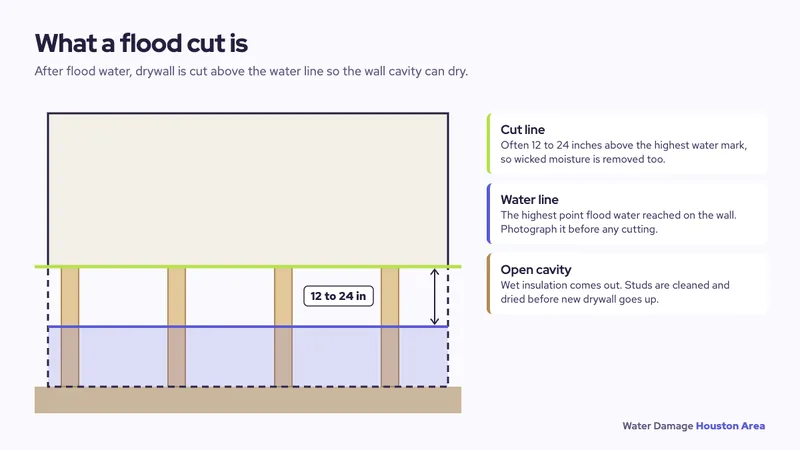
- Document first. Take photos of the water line on each wall and of every damaged item before anything is moved. Your insurer will ask.
- Pump and extract. Standing water and mud come off floors, garages and low rooms.
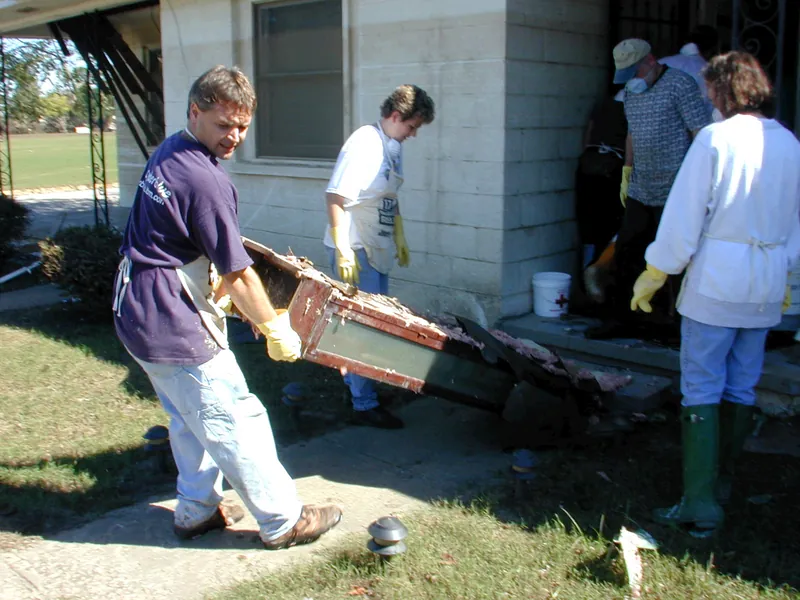
- Remove soaked materials. A flood cut takes drywall out above the water line, which lets the cavity dry and lets wet insulation be pulled.
- Clean and disinfect. Studs, subfloor, slab and every item that stays get cleaned and treated.
- Dry with equipment. Air movers and dehumidifiers keep running until moisture meters show dry readings. See structural drying.
- Check before closing walls. Rebuilding over wet framing is how hidden mold starts.
In a slab house the concrete itself is not the problem, but flooring laid on it is. Carpet, pad, laminate and wood flooring over a slab usually come up, and the slab is cleaned and dried before new flooring goes down.
What should you throw away after a flood?
Discard porous items the flood soaked that cannot be fully cleaned and dried. That means carpet and pad, mattresses, upholstered furniture, stuffed toys, wet insulation, low drywall, and any food or medicine the water reached. Take a photo of each item first, since the adjuster will ask.
| Category | Often cleaned | Often replaced |
|---|---|---|
| Flooring | Sealed concrete, tile | Carpet, pad and laminate |
| Walls | Wall framing, brick, masonry | Insulation and drywall under the cut line |
| Furniture | Glass, metal, some solid wood | Particleboard, upholstered pieces |
| Household | Dishes, hard plastic, metal tools | Mattresses, soft toys, food |
Appliances, air handlers and anything electrical that sat in flood water need a qualified technician's check before use. Keep a running list of item, room, rough age and where it was bought, because that list becomes your contents claim. See contents cleaning and pack-out for what a provider can sort and photograph.
On a claim, you and the adjuster decide what is kept or replaced. The provider does not.
How do you stop mold after flooding?
Speed matters: get soaked materials out and the structure dry. To prevent mold growth, the EPA says to get water-damaged areas dry in the first 24 to 48 hours and to hold indoor humidity below 60 percent, ideally 30 to 50 percent. The CDC gives the same 24 to 48 hour window for flood cleanup.
When the outdoor air is humid, opening windows can add moisture instead of removing it. Ask the provider how they will control humidity indoors while the building dries.
- Keep walls open until a meter shows the framing and subfloor are dry.
- The EPA cautions against painting or caulking over mold.
- When mold is left after flood water, the EPA recommends bringing in a professional experienced with contaminated-water damage.
- The CDC says people with asthma, mold allergy or weak immune systems can react badly to mold.
More on this is in mold after water damage.
Why does Houston flood so often?
Heavy rain in Harris County has to drain through its bayous and creeks. The Harris County Flood Control District divides the county into watersheds, each draining into a major bayou or creek. It also says a major flood occurs somewhere in Harris County about every two years.
Two storms show the scale. HCFCD lists Tropical Storm Allison in June 2001 as damaging 73,000 residences. The National Hurricane Center says Hurricane Harvey in 2017 put 36 to 48 inches of rain on the Houston metro area and flooded at least 160,000 structures in Harris and Galveston counties combined.
The NHC also reports that controlled releases from the Addicks and Barker reservoirs during Harvey further flooded some areas. For the causes in more depth, read why Houston floods and hurricane water damage.
How do you check a Houston address for flood risk?
Look the address up on FEMA's Flood Map Service Center for the effective flood map, then use the Harris County Flood Education Mapping Tool for local detail. HCFCD notes that its tool is not the effective FIRM, so use FEMA for the official zone. Neither map shows every street that floods.
Two zone terms come up often. Texas's seller notice describes the 100-year floodplain as Zones A, V, A99, AE, AO, AH, VE and AR, and the 500-year floodplain as shaded Zone X.
Texas law also pushes this information into sales and leases. The seller's disclosure notice under SB 339 asks about past flooding, reservoir releases and floodplain location, and landlords must give floodplain and past-flooding notices under Property Code 92.0135, with HB 531 effective January 1, 2022. Read the flood zone map guide and buying a flooded house before you sign.
Does insurance cover flood cleanup?
Normally not under a standard homeowners policy. According to Triple-I, flood damage is excluded from standard homeowners and renters policies, so protection comes from a separate policy, chiefly the National Flood Insurance Program (NFIP) or a few private insurers. FEMA adds that most homeowners insurance does not cover flood damage.
| Water source | Standard homeowners | Where cover comes from |
|---|---|---|
| Rising water from a bayou, street or storm | Excluded | Separate flood policy |
| Sewer or drain backup | Not typically covered | Separate endorsement or product |
| Burst pipe or appliance discharge | Often covered | Your homeowners policy |
Triple-I adds that sewer backups are not covered by a typical homeowners policy or by flood insurance. The NAIC says damage from ground water and rain runoff is not typically covered either.
FEMA's flood insurance manual describes a 30-day waiting period for new policies, with limited exceptions such as a loan closing. A policy bought as a storm approaches usually will not help. See the NFIP manual.
How do you file a flood claim and what are the Texas deadlines?
Contact the company or agent that sold your flood policy once it is safe, then document everything before cleaning. The Texas Department of Insurance says the company has 15 business days to confirm it received your claim, and 15 business days after getting what it needs to say whether it will pay.
- Report the loss and write down the claim number.
- Photograph and video every wall and item, including the water line, before anything moves.
- Protect the property. Triple-I advises taking reasonable steps to prevent more damage and holding off on major permanent repairs until the adjuster has assessed it.
- Keep every receipt and keep damaged items until the adjuster visits.
- Get itemized bids with materials and prices listed line by line.
TDI says a company can extend its decision deadline by 45 days if it explains why, and that after an agreement to pay it must pay within five business days. TDI can add 15 more days after a weather catastrophe, and a rejection must be explained in writing.
The TDI claim steps page lays this out. For more, read water damage insurance claims in Houston.
Can you get FEMA help after a flood in Harris County?
Help is available only if the flood falls under a federally declared disaster that includes individual assistance for your county. When it does, you apply at DisasterAssistance.gov with your address, insurance details and photos of the damage. Assistance covers needs; it does not replace insurance.
Apply even if an insurance decision is pending, and save every letter. Declarations are announced rather than automatic, so follow local news and county notices after a major storm.
Keep the provider's photos and drying logs too. Both an insurer and FEMA may ask for them.
What should you ask a flood restoration provider?
Ask which water category they assigned, what comes out and why, how they will measure dryness, and what the written scope covers. Providers differ on all of these, and this site cannot speak for any of them. Confirm everything directly before work starts.
- Will you photograph the walls and floors before removal?
- Which readings tell you the structure is dry?
- Is the quote itemized, and what could change it?
- Who handles the insurer, and what happens if the insurer pays less?
The guide to choosing a restoration company expands on this. If a business is flooded rather than a home, see commercial water damage restoration.
Sources: Ready.gov, Floods; IICRC, S500 standard; EPA, A Brief Guide to Mold, Moisture and Your Home; EPA, Mold Cleanup in Your Home; CDC, About Mold and Your Health; HCFCD, Watersheds; HCFCD, Flooding History; NHC, Hurricane Harvey report; HCFCD, Flood Education Mapping Tool; Texas SB 339; Texas HB 531; Triple-I, Which disasters are covered; Triple-I, Settling claims; NAIC, Homeowners Insurance; FEMA, Do not have flood insurance; FEMA, NFIP Flood Insurance Manual; TDI, Getting your claim paid; DisasterAssistance.gov.