The short version
For commercial water damage restoration in Houston, shut off the source, check safety and power, get people and stock clear, photograph everything, then contact your insurer and the building owner or landlord. Not every provider takes large commercial jobs, so confirm directly. Your commercial policy decides what is covered.
What should a business do first after water damage in Houston?
Shut off the water, make the space safe, get people and inventory out of harm's way, document the damage, then tell your insurer and the building owner or landlord. Work in that order. The first hour is mostly about keeping water from reaching more of the building before help arrives.
- Find and close the shutoff. Turn off the valve nearest the leak, or the main. A sprinkler discharge is different: the contractor who maintains that system may have to shut it down, so call them first.
- Check safety and power. Ready.gov warns against touching wet electrical equipment, or any electrical equipment while you stand in water, and says to cut the power only when that is safe. If the panel cannot be reached dry, call an electrician.
- Clear people first, then stock. Move staff and customers away from wet floors. After that, lift inventory, records and electronics off the ground, if you can do it safely.
- Record the loss before anything moves. Capture the damage on camera, including the source, the wet floors and the affected stock, before you shift or discard a thing.
- Call the insurer and the landlord or owner. Triple-I recommends reaching your agent or company right away, and waiting on major permanent repairs until an adjuster has looked at the damage.
- Then call a restoration provider and ask if it takes commercial jobs as large as yours.
A broken supply line follows much the same path as the burst pipe guide. Emergency water damage help lays out the full sequence.
How is commercial water damage different from a home loss?
The water itself behaves the same way. What changes is everything around it: several parties, a business that may need to keep running, bigger floor areas and building systems no house has. Those differences shape how the work is planned and who must sign off.
- Several parties. Tenant, owner and property manager can each answer for a piece of the building, and each may carry its own insurer.
- Lost business. A closed day can cost more than the repair, so plans bend toward operating hours.
- After-hours access. Night or weekend work needs keys, alarm codes and security arranged beforehand.
- Shared walls, ceilings and floors. Water moves into neighboring suites and the floors beneath.
- Sprinkler and fire systems. One discharge can put a large volume of water down fast.
- Bigger drying setups. More floor area calls for more equipment, and often more electrical capacity than a house needs.
A commercial job therefore tends to open with a longer talk about access, occupants and scope than a house job would.
Which water risks apply to which type of property?
Every property type has its own usual sources and planning needs, and the source often decides who gets the first call. Use the table as a general guide, not a forecast for any one building. A plumber, building engineer or your insurer can say what fits yours.
| Property type | Where the water usually comes from | Watch out for |
|---|---|---|
| Office | Rooftop units, restroom fixtures, supply lines, leaking ceilings | Server rooms, paper records, tenants downstairs |
| Retail store | Roof leaks, storefront runoff, supply lines, air conditioning drain lines | Stock on low shelves, flooring and display fixtures |
| Restaurant | Dishwashers, ice machines, floor drain backups, supply lines | Food safety, kitchen equipment and drain contamination |
| Church or school | Roof and gutter failures, restrooms, storm runoff | Large rooms and a fixed schedule for services or classes |
| Apartment building | Unit plumbing, water heaters, appliance leaks, roof | Several tenants, shared walls and ceilings, resident notices |
| Warehouse | Roof leaks, dock door runoff, floor drains, sprinkler discharge | Palletized stock, slab floors, tall ceilings |
Rental buildings overlap with several of these rows. The apartment and condo water damage page covers the tenant and unit side, and the roof leak guide covers storm leaks.
What happens when a sprinkler system discharges?
A discharge floods the building fast, and it can happen by accident. Triple-I names accidental discharge or overflow from automatic fire-protective sprinkler systems among the perils on standard policy forms. For a business, your own policy wording still settles what is covered.
The fire protection contractor who maintains the system, not a restoration provider, handles shutting it down and putting it back in service. Extraction and drying can begin once the water is off.
Tell the insurer how it happened: accidentally, because of a fire, or through damage to a pipe. The cause shapes the claim. Any fire damage is a separate matter from the water damage covered here.
Does commercial insurance cover water damage in Texas?
Possibly, though a commercial policy works differently from a homeowners policy, and the policy wording decides. What it covers, what it excludes and what it requires from you after a loss all vary. Read your policy or consult your agent before assuming anything about your own building.
Triple-I points out three things that hold for many policies. Standard homeowners and renters policies exclude flood damage, which needs its own flood cover, so put the same question to your agent about a business policy. A typical homeowners policy does not pay for sewer backups; that protection is added separately. Damage from poor maintenance is not covered either.
Also ask whether the policy pays for lost income while you are closed, and what it says about contents and stock. Raise flood on its own too, since water from outside is a different kind of loss from a plumbing leak.
The Texas Department of Insurance says the company has 15 business days after it gets what it needs from you to tell you whether it will pay, and must pay within five business days after agreeing. The insurance claims guide is written with homes in mind, yet its habits carry over: photograph first, save receipts, and hold on to damaged items until the adjuster has visited.
Who is responsible for the damage, the tenant or the owner?
That turns on the lease and on where the water came from, so pull out the lease and alert the owner early. Neither side is responsible by default: a tenant does not automatically own a leak inside a wall, and an owner does not automatically answer for a tenant's inventory. Do not guess.
Put the notice to the landlord or property manager in writing the moment you know, and keep a copy. Then ask three things: who arranges drying of the structure, who deals with contents, and which insurer sits on each side. A manager with several units should keep a single record covering every unit affected.
Texas has a flood disclosure law for rentals, but it is written for dwellings. The enrolled text of HB 531 requires landlords of residential leases signed or renewed on or after January 1, 2022 to say in writing whether they know the dwelling is in a 100-year floodplain or has flooded within the last five years. It does not tell you what a commercial lease says. A lawyer can explain lease questions; this site cannot.

Can a restoration provider handle a large commercial job?
Large jobs are not for every provider, so ask before you count on one. Some take commercial work and some do not, and size limits and service lists differ from company to company. This referral service connects you with independent providers and cannot tell ahead of time who will accept a particular building.
On the call, give the affected area's size, the property type and the water source. Ask whether work can happen after hours and how it would be arranged around people still using the space. If the provider cannot take it, ask who it would suggest instead.
Questions to put to any provider, plus warning signs, are in the guide to choosing a restoration company. Nothing here promises that a provider is available or takes commercial work.
How do you dry a commercial building?
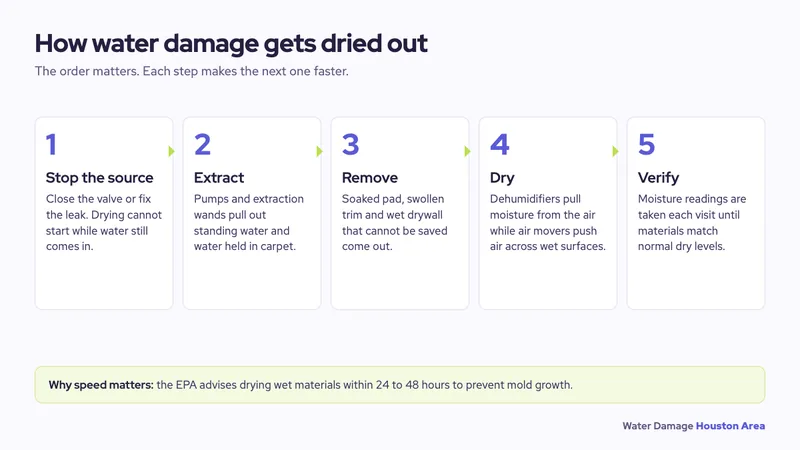
A commercial dry-out follows the same logic as a house, only bigger: shut off the source, pull out standing water, tear out what cannot be saved, run dehumidifiers and air movers, and confirm progress with moisture readings. Per the EPA, wet areas should be dried in the first 24 to 48 hours to head off mold, so the clock is the same.
A big floor plate calls for extra equipment, and the building may not have enough spare circuits to run it. Slab floors and masonry walls often hold moisture longer than they look, so ask to see moisture readings at every visit.
Structural drying explains how moisture gets tracked, and water mitigation describes the early work. The moisture meter readings guide explains what the numbers mean.
What if the water comes from a storm, a bayou or a sewer?
Assume it is contaminated until a professional tells you otherwise. IICRC S500 classes sewage, rising river and stream flood water, and outside surface water as Category 3. For buildings hit by contaminated water, the EPA says to bring in a professional who has experience with it.
A restaurant, or any building with floor drains, can see a backup push contaminated water into occupied areas, so keep people and food zones clear. Sewage backup cleanup and flood cleanup explain how those jobs differ.
Houston businesses have seen how large this can get. The NHC reports at least 160,000 structures flooded in Harris and Galveston counties during Hurricane Harvey in 2017, and HCFCD says a major flood occurs somewhere in Harris County about every two years. A building outside a mapped flood zone is not exempt. Ready.gov says flooding does not follow lines on a map.
How can a business prepare before the next storm or freeze?
Put the shutoff locations, the call list and the items to protect on one page, and make sure the right people hold a copy. That page saves the first and costliest minutes of a water loss. Ready.gov offers Ready Business toolkits for hurricanes, inland flooding and power outages.
- Shutoffs. Mark the main water valve, each suite's or area's valve and the water heater supply, then label and photograph every one.
- Sprinkler contact. Write down who maintains the system and the number to reach them.
- Call list. Policy numbers plus contacts for the plumber, electrician, owner, property manager, insurer and agent.
- After-hours access. Note who holds the keys and alarm codes.
- Move-first list. Name the records, equipment and stock that go first, and store them off the floor when possible.
- Freeze history. The TDI report on Winter Storm Uri says Texas had 511,473 insurance claims from the February 2021 freeze, with damage that included freezing pipes, and 112,163 of them in Harris County.
Hurricane Beryl in 2024 brought widespread power outages, per the NWS, so ask whether the plan covers a building with no power. The prevention guide lists common leak points, and the hurricane water damage guide covers storm season.
Where can a property manager find more help?
Start with the pages that match the source of the water, since the source decides the first call. A property manager with several buildings can use the water damage guides as a checklist library, and the glossary for terms that come up on a work order.
The service areas page lists the towns this referral service covers. Providers differ in what they take on, so confirm directly.
Sources: EPA, Brief Guide to Mold, Moisture and Your Home; EPA, Mold Cleanup in Your Home; Ready.gov, Floods; Ready.gov, Ready Business; IICRC S500; Triple-I, Settling insurance claims after a disaster; Triple-I, Which disasters are covered by homeowners insurance; TDI, Getting your insurance claim paid; TDI, Winter Storm Uri losses report; Texas HB 531, enrolled text; NHC, Hurricane Harvey report; HCFCD, Harris County flooding history; NWS Houston/Galveston, Hurricane Beryl summary.