The short version
For a burst pipe in Houston, close the nearest shutoff or the main valve, open a low faucet to drain the lines, photograph the damage, and call a plumber for the pipe and a restoration provider for the water. Wet materials should dry in the first 24 to 48 hours to avoid mold.
What should I do the moment a pipe bursts in my Houston home?
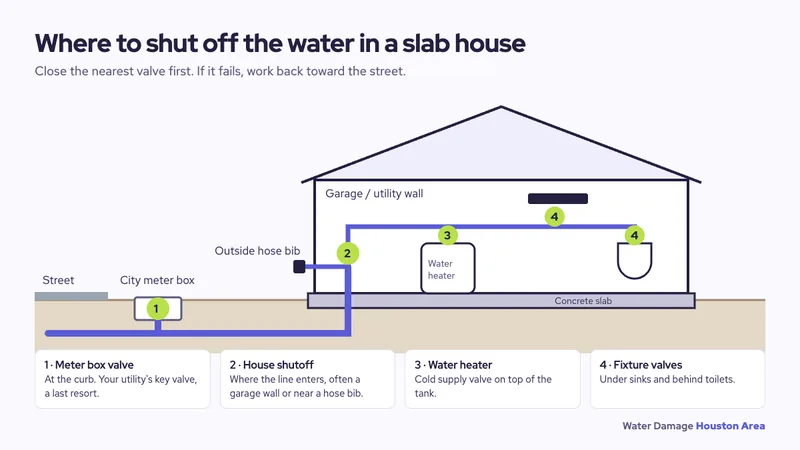
With a burst pipe in Houston, stop the water first. Close the shutoff valve nearest the leak, or the main house valve if you cannot tell where it is coming from. Then open a low faucet to drain the lines, and keep people and pets away from wet floors near outlets.
- Close the nearest valve, or the main shutoff if the source is unclear. The house valve is often on an outside wall or in the garage, and the meter box at the curb has a separate city valve. Do not operate the city valve unless the city tells you to.
- Switch off power to wet rooms at the breaker only if the panel is dry and you can reach it without stepping in water.
- Open the lowest faucet and flush nothing, so the pipes empty and pressure drops.
- Photograph and film the pipe, the water and every wet item before anything is moved.
- Call a plumber for the pipe and your insurer for the claim.
- Call a restoration provider for water removal and drying while the plumber works.
If the ceiling is bulging with trapped water, stay out from under it. The ceiling water damage page explains how a ceiling is drained safely. For wider water problems, see emergency water damage restoration.
Why do pipes burst in Houston when it rarely freezes?
Most burst pipes here come from two causes. A rare hard freeze splits pipes that were never built or insulated for it, and ordinary wear splits old or stressed pipes at a joint. Either way, the water often runs inside a wall or an attic before anyone sees it.
The Red Cross lists attics, garages and kitchen cabinets among the places where supply pipes are most at risk in cold weather. In a Houston house that means attic runs, garage lines and exterior walls. If your pipes there are bare, a hard freeze reaches them first.
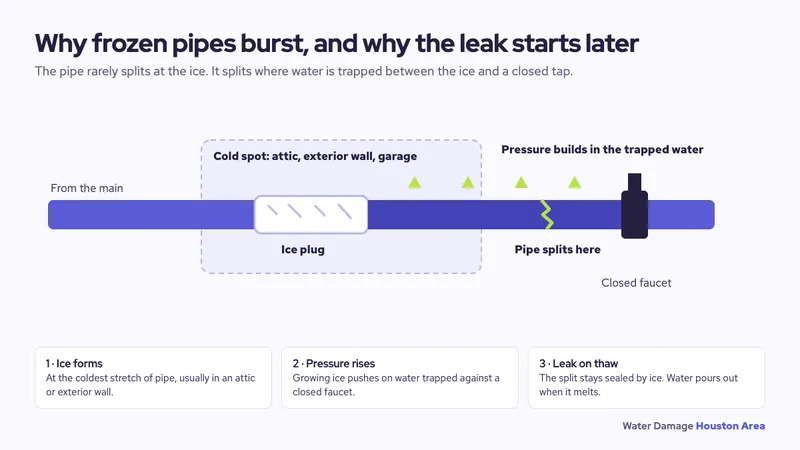
Freeze bursts also show up late. Ice blocks the pipe and pressure builds toward the closed faucet, so the split forms in the pipe but the water only pours out after the thaw. A house can look fine on a cold morning and be soaked by afternoon.
Not every burst is a freeze. Failed fittings, worn supply lines and aging pipe materials leak in any season, and the galvanized pipe leaks page covers one common older-home case.
How do I thaw a frozen pipe safely?
Open the faucet, then warm the pipe slowly with a hair dryer, an electric heating pad or towels soaked in hot water. The American Red Cross also allows a portable space heater kept away from anything flammable. Start near the faucet and work toward the frozen section.
- Keep the faucet open so melting water has a way out.
- Never use a blowtorch, kerosene or propane heater, charcoal stove or any open flame, which the Red Cross warns against.
- If you cannot reach the frozen section, such as a pipe inside a wall, stop and call a plumber.
- If a pipe has already split, close the main valve before you apply any heat.
Once the ice melts, walk the house and look for drips, wet drywall and stains on ceilings. A pipe that thawed without leaking can still be cracked, and the crack shows only when water flows again.
Where do burst pipes show up in a Houston house?
Burst pipes cluster in unheated or hard-to-see spaces. The table below matches the usual spots to the first sign and the person to call. Houston homes sit mostly on slabs, so the lines in the attic and walls are often the ones in the open air.
| Location | Why it fails | First sign | Who to call |
|---|---|---|---|
| Attic supply lines | Exposed to cold air with little insulation | Ceiling stain or drip below the line | Plumber, then a restoration provider |
| Exterior walls | Cold passes through the wall and chills the pipe | Damp drywall, bubbling paint | Plumber |
| Garage lines and water heater supply | Unheated space, often with bare pipe | Water on the garage floor | Plumber |
| Outdoor hose bibs and irrigation lines | Water left standing in exposed pipe | Spray or a wet wall behind the spigot | Plumber or irrigation contractor |
| Pipes under the slab | Wear, ground movement or corrosion rather than cold | Warm floor spot, running-water sound, a meter that moves | Plumber with leak detection |
A slab leak behaves differently from a freeze burst, and the slab leak page explains the warning signs. The guide to signs of water damage shows what to look for in each room.
How did Winter Storm Uri hit Texas homes?
Winter Storm Uri was a prolonged freeze in February 2021 that broke pipes across the state. The Texas Department of Insurance reports that most of Texas stayed in frigid cold, ice and sleet from February 11 to 19, with rotating power outages and freezing pipes among the damage.
TDI's report, with figures as of June 30, 2022, counted 511,473 insurance claims statewide and about $11.5 billion in expected insured losses. Harris County alone had 112,163 reported claims and about $2,038.8 million in case-incurred losses.
The average incurred loss on residential property policies was about $17,800, and TDI puts the average time to close a residential claim at 61.4 days. Of the Harris County claims, 61.1 percent closed with payment and 36.1 percent closed without payment, so a claim is not automatic.
The lesson for a Houston owner is practical. A freeze can hit many homes in the same week, plumbers and drying crews get busy, and early documentation and a quick shutoff matter more than anything else you do.
How do I report a water main or meter leak in Houston?
Use the City of Houston 311 service. Houston Public Works says to request services and report issues using 311, and the City's 311 site has a Make a 311 Request option. Confirm the right category with 311, because the site text does not list a leak category.
The dividing line is usually the meter. Water on the street side of it, such as a leak at the curb box or in the street, is generally a city utility issue. A leak on the house side is generally yours, and you call a plumber. If you cannot tell which side it is, report it and ask.
Closing the house shutoff stops water from entering the home but does not stop a leak in the city line. Take a photo of any water at the curb with the date visible, and note the address.
You can start a request on the City of Houston 311 site. The Houston Public Works site links to the same service.
How can I tell if a pipe is leaking inside a wall or attic?
Look for slow signs that grow over days. Stains that spread, paint that bubbles, a musty smell and a water bill that jumps with no change in use all point to a hidden leak. Confirm the source before any wall is opened.
- Turn every fixture off and watch the water meter. If the dial keeps moving, water is escaping somewhere.
- Check the ceiling and walls for new stains, soft spots or warm patches.
- Look at the attic from the access hatch if it is safe, using a flashlight. Do not step between the joists.
- Ask a plumber for a pressure test or leak detection rather than cutting blind.
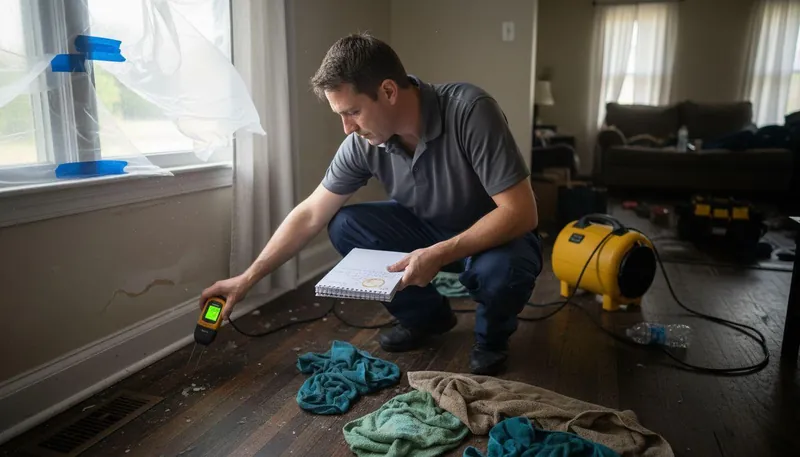
- Ask for a moisture meter reading on suspect surfaces. The moisture meter readings page shows what the numbers mean.
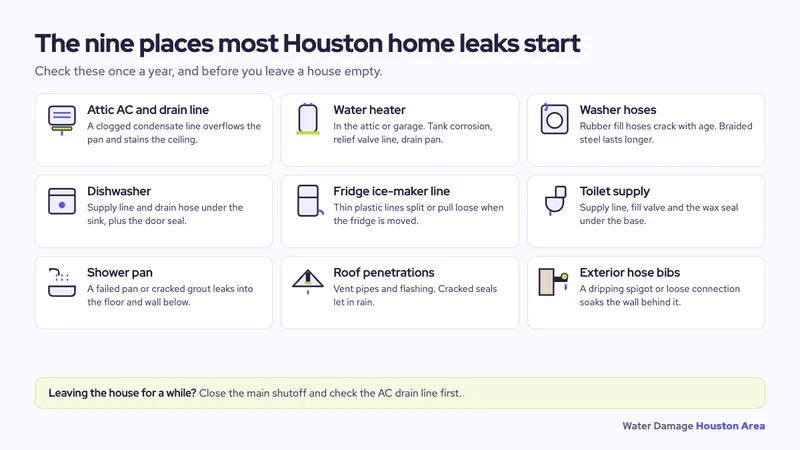
Water in an attic can also come from the air conditioner or the water heater, so rule those out. See AC leak water damage and water heater leaks.
Does homeowners insurance cover a burst pipe in Texas?
Often yes, when the water is sudden and accidental. The Insurance Information Institute lists accidental discharge or overflow of water from plumbing as a named peril on standard forms, along with freezing of those systems. The exact wording of your policy decides.
The NAIC says water damage from a home's plumbing is typically covered, while ground water and rain runoff are not. Triple-I adds that policies will not cover damage from a lack of maintenance, and the cost of mold is often excluded or limited.
Coverage usually applies to the damage the water caused. The cost of fixing the pipe itself and the repair of long-running leaks are the parts most often disputed, so read the policy or ask your agent in plain terms.
The full process is in the water damage insurance claims guide. For how a sudden event differs from a slow one, see sudden vs gradual leaks.
How do I file a burst pipe claim and what are the TDI deadlines?
Call your insurer or agent right away, protect the property from further damage, and hold off on major permanent repairs until the adjuster has looked. Triple-I also says to save receipts, photograph the damage and keep damaged items until the adjuster visits.
The Texas Department of Insurance says your company has 15 business days to confirm it received your claim, and 15 business days after it gets what it needs to say whether it will pay. It can extend that by 45 days if it explains why, and TDI can add 15 more days after a weather catastrophe.
If the company agrees to pay all or part of the claim, TDI says it must pay within five business days. If it rejects the claim, it must say why in writing.
If you disagree with the result, Triple-I notes that many policies allow an independent appraisal. You can also ask TDI for help through its complaint page or the questions line at 800-252-3439.
What water category is a burst pipe, and how is it dried?
A burst supply pipe is usually Category 1, clean water, under IICRC S500. That changes if the water sits, picks up dirt or soaks into materials for a long time, so the provider confirms the category on site. Drying then follows a set order.
- Stop the source and extract standing water.
- Remove wet materials that cannot be saved, such as saturated insulation or swollen drywall.
- Dry with air movers and dehumidifiers.
- Take readings at each visit to show progress.
- Repair only after the materials read dry.
The EPA says to dry water-damaged areas and items within 24 to 48 hours to prevent mold growth. Read about water removal and structural drying, and mold after water damage if the area stayed wet. Providers differ in what they offer, so confirm the scope directly.
How do I stop pipes bursting during the next freeze?
Insulate exposed pipes, let faucets drip, and keep the heat on. The Red Cross says to leave the thermostat no lower than 55 F when you are away, keep it steady through day and night, and let cold water drip from faucets served by exposed pipes.
- Wrap attic and garage pipes with insulation made for pipes.
- Cover or disconnect outdoor hoses and protect hose bibs.
- Open cabinet doors under sinks on exterior walls so room air reaches the pipes.
- Learn where your main shutoff is before a freeze, and test that it turns.
- Ask a plumber about pipes in walls that face north or run through the attic.
The water damage prevention guide adds a year-round checklist. For storm-driven water that comes from outside the house, see hurricane water damage.
Sources: American Red Cross, Frozen Pipes; TDI, Winter Storm Uri losses report; TDI, steps to getting your insurance claim paid; TDI complaint page; City of Houston 311; Houston Public Works; Triple-I, Which disasters are covered by homeowners insurance; Triple-I, Settling insurance claims after a disaster; NAIC, Homeowners Insurance; IICRC S500; EPA mold and moisture guide.