For Katy homeowners
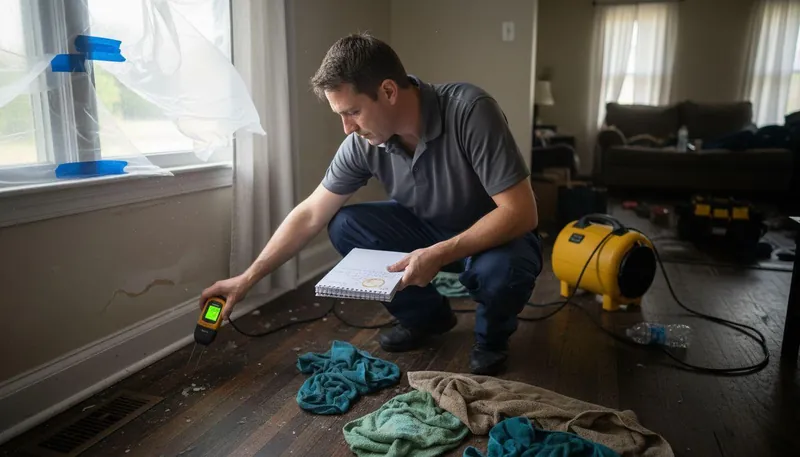
For water damage restoration in Katy, TX, shut off the main valve, photograph everything and start drying in the first 24 to 48 hours. Rising outside water is Category 3 flood water and is not covered by standard homeowners policies. We take requests from the four Katy ZIPs.
Which Katy addresses do you take requests from?
Requests come in from Katy 77449, Katy 77450, Katy 77493 and Katy 77494, plus PO boxes in Katy. A restoration provider confirms whether they can reach your street when they call, because providers differ on how far they drive. Houston's Energy Corridor, to the east, has its own page.
Katy is unusual because one town sits in three counties. Read on to see why that matters for flood maps, inspections and who answers the phone at the county. Neighbors have their own guides: West Houston and the Energy Corridor, Richmond and Rosenberg, Cypress and Sugar Land.
Which county is my Katy house in, and does it matter?
It can matter. Wikipedia says Katy sits at the tripoint of Harris, Fort Bend and Waller counties, along Interstate 10, about 29 miles west of downtown Houston. Your county decides which commissioner precinct serves you and which county offices you deal with after a loss.
The city is also smaller than the name suggests. Wikipedia says Greater Katy takes in unincorporated land across the 181-square-mile Katy school district, and that a home can have a Katy mailing address without being inside city limits. The table below shows the three pieces.
| Piece of Katy | What Wikipedia says | What to check after a leak |
|---|---|---|
| Old Towne Katy | The part incorporated in 1945, with Cane Island Creek as a boundary | City permits and city services apply |
| Greater Katy | City plus unincorporated land across the school district | Your county, not the city, may be your local government |
| Fort Bend side | Served by Fort Bend County Precinct Three | Ask the county where flood records are kept |
| Harris side | Served by Harris County Precinct Three | Check Harris County flood tools |
If you are not sure which side you are on, your property tax bill or county appraisal record will show it.
Does Katy flood?
It can. Wikipedia says Buffalo Bayou has its source near Katy, and the fertile floodplain of the bayou and its tributaries drew rice farmers to the prairie. Cane Island Creek, a branch of the bayou, runs through town, and the early settlers dealt with thick clay soil.
The same article records how fast water can destroy a young town. The Great Galveston Hurricane struck on September 8, 1900, and all but three of the original Katy homes were lost. Hurricane Harvey in 2017 brought 36 to 48 inches of rain to the Houston metro, according to the National Hurricane Center.
Water that rises from outside is flood water. The IICRC S500 standard puts rising flood water in Category 3, which needs professional handling. Our flood zone guide explains how to look up your address, and flood cleanup covers what happens next.
Do the Addicks and Barker reservoirs affect Katy homes?
They affect homes near them, and they matter to anyone buying or insuring a house in that part of west Houston. The reservoirs sit east of Katy in western Harris County and hold back water to protect Buffalo Bayou downstream. Whether a given street is inside a reservoir pool is something to confirm for your own address.
The Harris County Flood Control District says the Army Corps of Engineers began releases on August 28, 2017. It says rising reservoir water flooded streets and homes upstream, the first time that had happened in the 70-plus-year history of the dams. Wikipedia adds that Addicks peaked at 109.1 feet on August 30, 2017, its highest recorded level.
Three other points from HCFCD and Wikipedia's Barker article are worth knowing:
- Some downstream streets and homes flood when the combined release rate passes about 4,000 cubic feet per second.
- Addicks and Barker give no flood reduction benefit to property upstream of the dams.
- Texas Senate Bill 339 made the seller's disclosure ask about past reservoir flooding and whether the property is in a flood pool, for contracts from September 1, 2019. Read buying a flooded house before you sign.
How did fast growth shape the houses in Katy?
Katy changed from a railroad and rice town to a suburb in a few decades. Interstate 10 opened in 1966, and Wikipedia says Houston's growth then moved west along it. Homes in one subdivision can be a different age and build than the one across the road, so look up your own.
The same article names suburbs from the 1970s and 1980s, including Memorial Parkway, Kelliwood and Nottingham Country. Cinco Ranch, Seven Meadows, Firethorne and Grand Lakes belong to Greater Katy, and Pin Oak Village and The Enclave are in Old Towne. Wikipedia gives no build year for each.
Ask your seller or inspector how old your house is and what has been replaced.
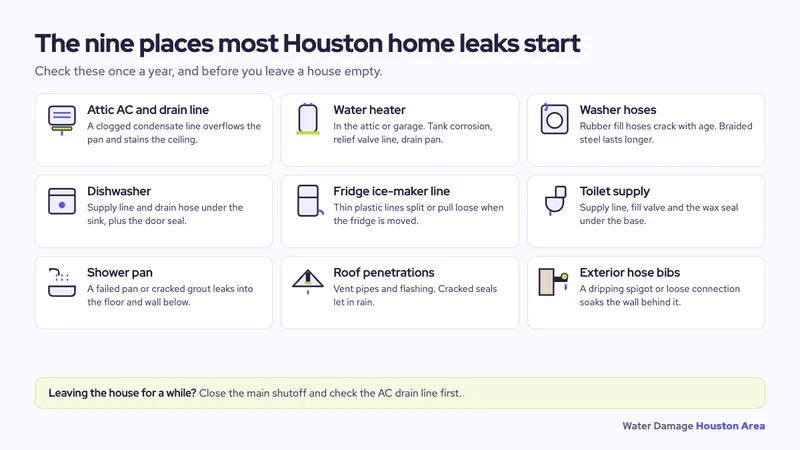
If your house sits on a slab, a leak under the floor is as likely as one in the ceiling. See slab leak damage and AC leak damage for the usual signs.
What is left of the rice town in Katy's history?
The old center is still there. Wikipedia says the town was laid out in 1895 and named for the MKT railroad, "the K-T", and that rice became the main crop. The first concrete rice driers in Texas went up in Katy in 1944.
The historic town square follows the old railroad right-of-way, according to Wikipedia. Older buildings there may have been renovated several times, so tell the provider what you know about past repairs. Business owners can read commercial water damage.
Will insurance pay for flood water in Katy?
Usually not. The Insurance Information Institute says flood is excluded under standard homeowners and renters policies, and cover is a separate policy from the NFIP or a private insurer. FEMA also says most homeowners insurance does not cover flood losses.
A sudden plumbing leak is a different case. The NAIC says water damage from a home's plumbing or a roof leak is typically covered, while ground water and rain runoff are not. A reservoir pool or a creek that rises over a yard is flood water, not a plumbing event.
Call your agent before signing a work order. The Texas Department of Insurance explains in its claim steps that your company has deadlines to acknowledge and decide a claim. Our claims guide lists what to photograph.
What should I do in the first 24 to 48 hours?
Stop the water, keep people safe, then start drying. The EPA says to dry water-damaged areas and items within 24 to 48 hours to prevent mold growth, and to keep indoor humidity below 60 percent, ideally between 30 and 50.
- Shut off the main water valve. Turn off power to wet areas only if you can do it safely.
- Photograph and video the damage before anything is moved.
- Call your insurer and ask what it needs before work begins.
- Call a restoration provider and ask what they will measure and how they will record drying.
- Stay out of standing outside water. Ready.gov warns that six inches of moving water can knock a person down.
The emergency page has a longer list, and mold after water damage covers growth that has already started. Providers differ on coverage, so confirm they will come to your address.
Sources: Katy, Texas, Addicks Reservoir and Barker Reservoir (Wikipedia); HCFCD, flooding impacts in connection with the reservoirs; NHC, Hurricane Harvey report; Texas SB 339; IICRC S500; Triple-I, disasters covered by homeowners insurance; FEMA, flood insurance; NAIC, homeowners insurance; TDI, getting your claim paid; EPA, mold and moisture; Ready.gov, floods.