The short version
Growing stains, a musty smell, bubbling paint, warped floors and soft drywall make up the signs of water damage. A damp area that keeps changing is an active leak. Shut off the water, photograph everything, then call a plumber to trace the source and a restoration provider to deal with what got wet.
What are the signs of water damage in a Houston house?
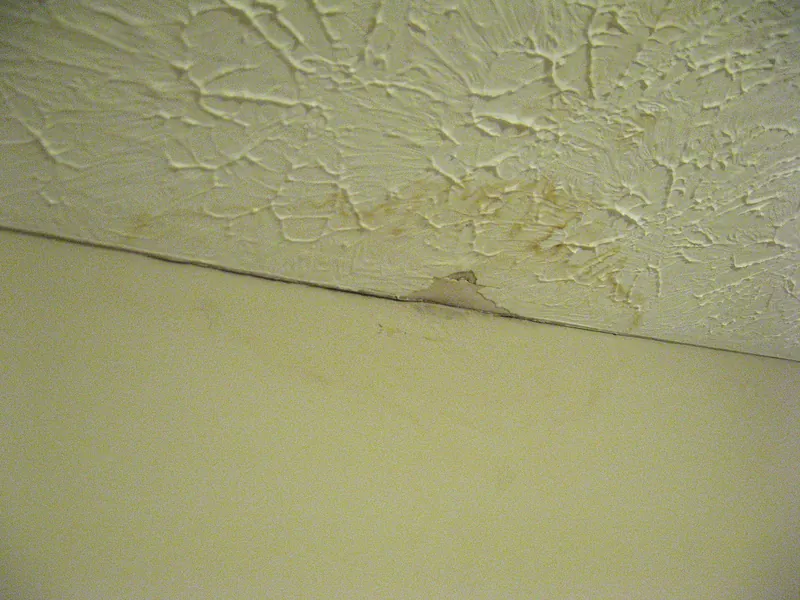
The signs of water damage to look for are stains that keep growing, a musty smell, bubbling paint, floors that cup or lift, and drywall that feels soft. Any one can have another explanation. When two or three show up together, or one keeps changing, water is usually still getting in.
- Stains in brown, yellow or gray, frequently with a darker ring around the edge.
- Smell like wet cardboard or damp soil, strongest after the house has been shut up.
- Surface changes such as bubbling paint, peeling wallpaper or rust on metal.
- Movement: swollen baseboards, buckled floors, doors that start to stick.
- Sound of dripping or running water when every fixture is off.
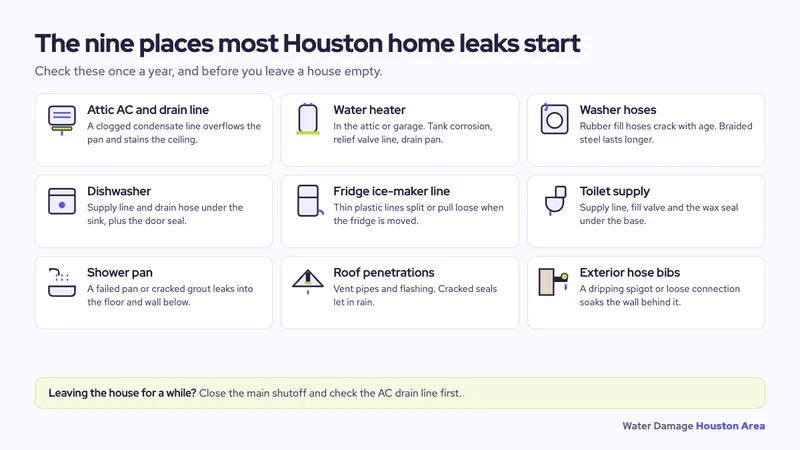
Houston adds its own causes. A clogged air conditioner drain, a leak in a line under the slab and a roof leak after a storm all start quietly.
What does hidden water damage look like?
Hidden water damage shows up as faint clues some distance from the leak: a light stain, an odor with no obvious source, or a floor that gives slightly underfoot. The water itself sits inside a wall, beneath flooring or above a ceiling, out of sight.
Hidden leaks get costly because of the clock. The EPA says to dry water-damaged areas and items in the first 24 to 48 hours to prevent mold growth, and a leak running for weeks gives mold plenty of time.
Start with the places water likes to hide: behind toilets, under sinks, around the water heater, in closets that share a wall with a bathroom and in the attic around the air handler. The water damage glossary explains terms you may hear from a provider.
Which signs show up in which room?
Leaks tend to favor certain rooms, so where you see the sign helps narrow the source. Use the table to get started, then confirm with a plumber or a restoration provider. Providers differ in what they inspect, so ask what a visit covers.
| Room | What shows up | Probable cause | Next move |
|---|---|---|---|
| Kitchen | Puffy cabinet bottom, spongy floor by the dishwasher, musty smell inside the cabinet | Sink supply or drain, dishwasher hose, ice maker line | Clear the cabinet, check for drips, then call a plumber |
| Bathroom | Spongy floor near the toilet, cracked grout, a stain on the ceiling underneath | Toilet wax ring, shower pan, tub seal or supply line | Stay off the fixture, then get a plumber |
| Laundry room | Damp floor, rust on a hose fitting, a stained wall | Washer hose, drain box or a water heater close by | Close the washer valves and replace the hose |
| Hall or bedroom ceiling | Brown stain, sag, drip during or after rain or when the AC runs | Attic AC drain line, roof leak, pipe in the attic | Check the attic if it is safe, see the ceiling page |
| Floors over a slab | Warm spot, damp or lifting flooring, sound of running water | Leak in a supply line under the slab | Run the meter test, call a plumber |
| Garage | Puddle by the water heater, rusted tank base, damp drywall | Water heater, relief valve, supply connections | See the water heater page |
What are the signs of a slab leak?
A slab leak can show as a warm spot on the floor, the sound of running water with everything off, a water bill that climbs without a change in habits, or flooring that turns damp from below. Not every house on a slab has this problem. If yours does, these signs point to it.
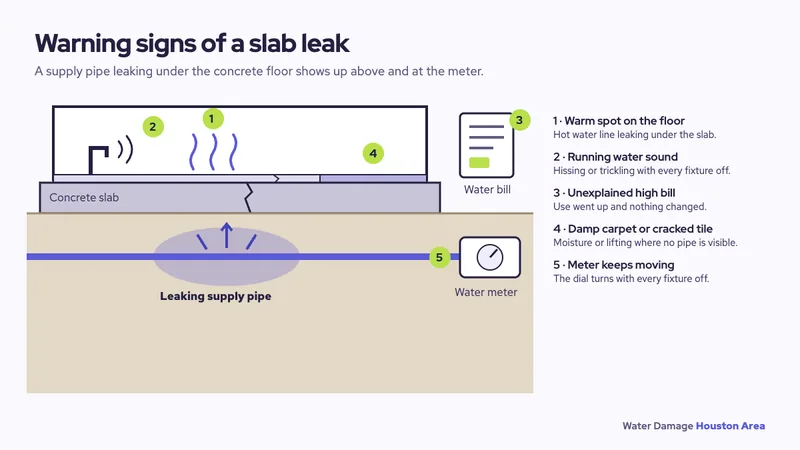
A plumber confirms the location with listening or pressure tests. See the slab leak page for what happens to wet flooring afterward.
Where do ceiling stains come from when the AC is in the attic?
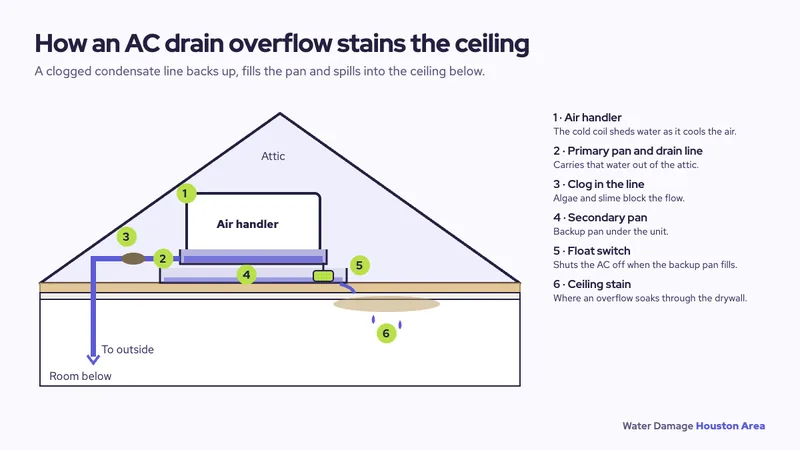
A stain under an attic air handler often comes from the condensate drain line. When the line clogs, the pan under the unit fills and water can overflow onto the ceiling below. Roof leaks and attic pipes cause similar stains, so check the timing.
- A stain that grows when the AC runs on a dry day points to the drain line.
- A stain that grows during or after rain points to the roof.
- A stain that grows no matter the weather points to a pipe.
Many systems have a float switch that shuts the unit off when the pan fills. Providers and HVAC technicians differ on what is installed, so ask. The AC leak page covers cleanup.
How can I tell if water damage is old or new?
Fresh damage is damp, dark and still changing, while old damage is dry, stable and often has a hard edge. That matters because an active leak keeps spreading until someone stops it, and only a wet area suggests one is running.
| What to check | Active leak | Old, dried stain |
|---|---|---|
| Touch | Cool and damp to soft | Dry and firm |
| Outline | Soft, spreading border | Crisp ring, sometimes several |
| Day to day | Gets larger or darker | Looks the same |
| Odor | Fresh, wet smell | Stale, or nothing |
Trace the edge in pencil and write the date beside it. Look again after the next rain and the next day the AC runs hard. A stain that stays inside the line is probably old. Rings inside rings mean water has returned more than once.
How can I test for a leak with the water meter?
Think of the meter as a lie detector. If nothing in the house is using water and the meter still moves, water is escaping somewhere. Close every fixture, the ice maker and the irrigation timer, then watch the leak indicator or the dial.
- Photograph the dial before and after a quiet stretch with no water use, so you are not comparing from memory.
- Rule out slow users first: toilet flappers, a humidifier, a water softener cycle, a sprinkler timer.
- Close the house shutoff and watch again. If the meter stops, the leak is inside; if it keeps moving, it is on the line before the house.
- Compare the last few water bills. A rise with no change in habits is a clue.
The burst pipe page covers shutting the water off. A plumber can pressure-test the lines if the source stays hidden.
What are the signs of a leak behind a wall?
Paint that blisters, a stain nowhere near a fixture, a swelling baseboard and a spot that is cool to the touch all point to a leak behind a wall. You may also catch a faint hiss or drip if you listen with the house quiet.
- Press on the wall lightly. Drywall that feels soft or crumbly is wet.
- Slide a hand along the baseboard. Cupped or warped stretches suggest moisture behind or below.
- Check the other side of the wall, often a bathroom, kitchen or laundry room.
- If outlets or switches on the wall are wet, leave them off and stay away from them.
Wait to cut into a wall until the water and power to it are off. After that, a restoration provider may cut open the lower part of the wall so the cavity can dry. Drywall water damage repair explains the steps that follow.
How serious is it? A simple triage
Sort each finding into one of three bins: monitor it, bring in a plumber, or get a restoration provider out right away. Urgency rises with the amount of water, the time it has been there and how much material it touched.
| Situation | Urgency | What to do |
|---|---|---|
| An old stain that is dry and has not changed | Watch | Outline it, recheck after rain, and refinish only once you are sure it is dry |
| A slow drip under a sink, a running toilet or a moving meter | Call a plumber | Close the local valve or the house shutoff |
| Soaked carpet, wet drywall, a sagging ceiling or standing water | Restoration provider now | Stop the water, take photos, then call |
| Sewage, a backed-up drain or outside flood water | Call now, stay out | See the sewage backup page |
IICRC's S500 standard sorts water into categories, with sewage and rising flood water in the grossly contaminated Category 3. When in doubt, treat the area as wet and act before it spreads.
What does a leak detection or moisture inspection involve?
Expect questions first, about when you noticed the signs, followed by a look at the suspect area and some measurements. Most inspections lean on two tools. One is a moisture meter that measures moisture in drywall and wood; the other is a thermal camera, whose images reveal temperature differences that can mark wet spots. Plumbers add listening devices and pressure tests.
Take these as general descriptions. Tools and scope vary by provider, so ask each what the visit covers. Whoever inspects should record the readings and where each was taken.
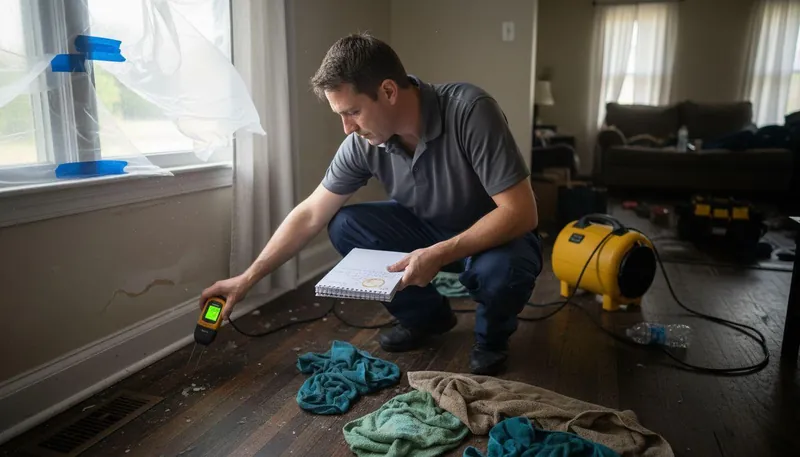
Plumbers trace the water to its origin, while restoration providers map where it traveled, which often means two separate visits. The moisture meter readings guide explains the numbers.
What should I do after I find signs of water damage?
Shut off the water if you can, record what you see, then ask for help. Close the closest valve first, take photos second and make calls third. Repairs wait until the water has stopped and the wet materials have been checked.
- Shut off the water at the fixture valve or the house shutoff. Switch off power to wet areas only if the panel can be reached dry.
- Take photos and video of the signs from several angles.
- Move contents out of the wet area.
- Call your insurer. Triple-I recommends limiting further damage to the property while putting off big permanent repairs until the adjuster has looked at it, and saving receipts.
- Line up a plumber for the leak itself and a restoration provider for anything that got wet.
Coverage depends on the cause. NAIC says water damage from a home's plumbing or a roof leak is typically covered, while ground water and rain runoff are not. Triple-I adds that policies will not cover damage from lack of maintenance. See the insurance claims guide.
When do the signs mean mold?
Fuzzy or dark spots, or a musty smell that will not leave, can mean mold is growing. Mold needs moisture, so it hints at a leak that has not been fixed. The EPA says a moldy area smaller than about 10 square feet can in most cases be handled by you.
Larger areas, spots that return after cleaning and water from sewage call for a professional. The mold after water damage guide covers what to clean and what not to. The EPA advises against painting or caulking moldy surfaces.
Per the CDC, mold effects include a stuffy nose, coughing and wheezing, which is why people with asthma should keep out of the area.
To get help drying out what you found, reach out through the contact page and ask to be connected with a restoration provider for your area.
Sources: NAIC, Homeowners Insurance.; Triple-I, Which disasters are covered by homeowners insurance; Triple-I, Settling insurance claims after a disaster; IICRC, S500 standard; CDC, About Mold and Your Health; EPA, Mold Cleanup in Your Home; EPA, A Brief Guide to Mold, Moisture and Your Home