The short version
For ceiling water damage repair, turn off power to the room and set a bucket at the sagging low point, then puncture it from the side so the water comes out slowly. Next find the source: timing separates a roof leak from an AC line, a bathroom or a water heater. Soft or sagging drywall gets replaced.
What should I do when water is coming through the ceiling?
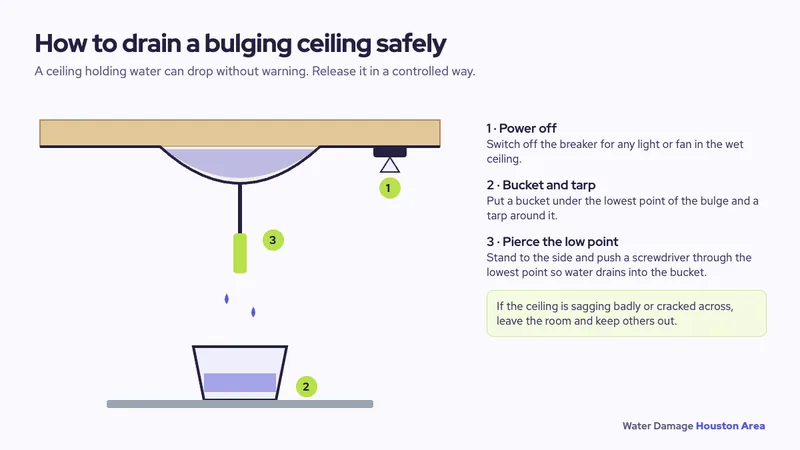
Cut power to the area first, then give the trapped water a path out. Wet drywall is heavy and can fall with no warning, so do the steps in order and keep clear of any bulge until it has drained. Deal with the source above once the room is safe.
- Turn off the breaker feeding every light, fan and outlet on or beneath the wet section.
- Clear the floor. Move furniture, rugs and electronics aside and lay down a tarp or towels.
- Set a bucket under the lowest point of the bulge.
- Pierce the low point with a screwdriver while standing to the side, so the water runs into the bucket.
- Stop the source above the ceiling. If a pipe or fixture is feeding it, close the nearest valve or the main shutoff.
- Photograph the ceiling before you clean up, and call your insurer.
Not sure where the main shutoff is on a slab house? The prevention guide shows the usual spots, and the water damage repair page explains what happens after the water stops.
What are the warning signs a ceiling may collapse?
Collapse tends to announce itself. Watch for a bulge that keeps getting bigger, cracks that spread, joint tape lifting, screw heads showing through the paint, or a patch that feels soft under a fingertip. If you notice any of these, move everyone out of the room.
- A bulge where you can see or hear water shifting overhead.
- Fresh cracks running along seams or circling a fixture or fan.
- Drips from several points at once.
- Texture or paint that has blistered and sags in a sheet.
Only a small bulge is worth draining yourself, using the low-point method in the diagram above. When a whole panel droops or splits, close the door, kill the power to that room and get help. Do not poke at a large sag from below.
Is my ceiling stain new, old or an active leak?
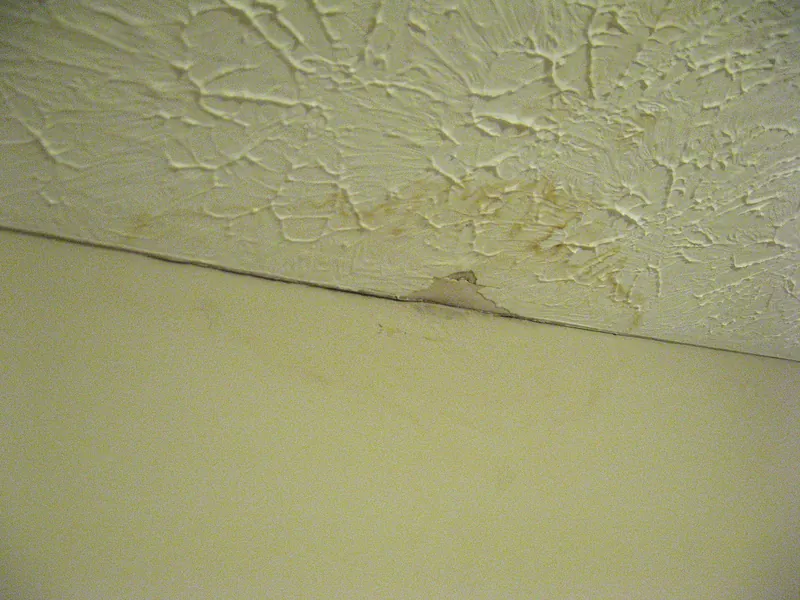
New stains are cool and damp to the touch, darker toward the center, and they spread over a few days. Stains from an old leak are dry, ringed by a firm brown or yellow edge, and stay put. Multiple nested rings show the leak has come back repeatedly.
- Push lightly on the area around the stain. If it gives like a sponge, it is still wet.
- Mark the edge with a pencil line, then look again after the next rainfall, shower or AC cycle. Growth past the line means the leak is live.
- Get a moisture reading with your own meter, or ask a restoration provider for one. The moisture meter guide explains what the numbers mean.
Once a repaired leak has left a dry stain, primer and paint will cover it. A stain that is still fresh says water is entering, so track down the source before any cosmetic work. The signs of water damage guide helps with stains in other rooms.
Where is my ceiling leak coming from?
Note exactly when the dripping starts or the stain spreads. That timing points to the source before anyone cuts into drywall, and the table below pairs each pattern with the trade that fixes it. Water also follows joists, wires and pipes, so the stain can sit well away from the actual leak.
| What you notice | Probable cause | Who handles it |
|---|---|---|
| The stain shows only in or after rain | Roof surface, flashing, a vent boot or a window above | Roofer |
| The air conditioner is running | Clogged condensate line or full drain pan under an attic air handler | HVAC technician |
| Someone showers on the floor above | Shower pan, tub overflow, grout or a drain seal | Plumber |
| A toilet above is flushed | Wax ring or supply line | Plumber |
| Around a water heater in the attic | Tank, fittings, relief valve line or a full drain pan | Plumber |
| All day and all night | Pressurized supply line or fitting | Plumber, and close the main shutoff |
A single-story house still has an attic above every ceiling, so attic equipment and the roof cause many Houston ceiling stains.
Why do attic air handlers cause ceiling leaks?
If your air handler sits in the attic, it pulls water out of the air as it cools the house and sends that water down a condensate line. When the line clogs, water backs up into a drain pan. Once the pan overflows or rusts through, the water runs onto the ceiling below.
These leaks follow the cooling cycle, so the stain grows when the AC runs and stops when it is off. A float switch in the pan can shut the system down before it overflows, and a technician can clear the line and check the pan.
The AC leak page covers the pans, the float switch and sweating ducts in more detail. Turn the system off if you see water dripping from it, then call an HVAC technician. Drying the ceiling will not help if the line is still clogged.
Can an attic water heater leak through the ceiling?
Yes. A tank in the attic has living space under it, so a slow drip from the tank, a fitting or the relief valve line can soak insulation and drywall before anyone sees it. A drain pan under the tank catches small leaks, but it only helps if the pan is draining where it should.
- Look for rust trails, a damp pan or water around the base of the tank.
- If the leak is active, close the cold water valve on top of the tank.
- For a gas unit, turn the gas control to off. For an electric unit, switch off its breaker.
Our water heater leak page covers the shutoff steps in order. A plumber repairs or replaces the tank, and a restoration provider handles the wet insulation and ceiling. Services differ by provider, so confirm what each one handles.
Can a roof leak cause a ceiling stain after a storm?
It can. Rain finds gaps at flashing, vent boots, chimneys and damaged shingles, soaks the insulation, then shows up as a stain that may be several feet from the opening. Stains that appear only during or after rain point to the roof, not the plumbing.
After a hail or wind storm, a leak can take a while to appear because water sits in the insulation first. Read the roof leak and storm damage page for the full sequence, and the hail storm hidden leaks guide if the stain showed up weeks later.
A roofer fixes the opening. Drying the ceiling before the roof is sealed only works if no more water is coming in.
Can a water-damaged ceiling be saved?
A small leak of clean water can often be dried and repainted. Drywall that has gone soft, sagged or started to crumble has lost its strength, so it gets cut out and replaced. Two things decide it: how long the material stayed wet and what the water carried.
- A small stain from a quick, clean leak can usually be dried, sealed with a stain-blocking primer and repainted.
- Soft, sagging or crumbling drywall is replaced rather than dried.
- Wet insulation holds water against the drywall and framing. It usually has to come out so the cavity can dry.
- Older plaster ceilings dry slowly and can separate from the lath, so have one checked before anyone stands under it.
Before the ceiling is closed or painted, a restoration provider should check the drywall and framing with a moisture meter. Paint over damp drywall seals the moisture in, and the stain returns.
When does the drywall have to come down?
Drywall comes down when it is soft, sagging, stained through, or when it covers wet insulation that cannot dry any other way. The IICRC S500 standard sorts water by how contaminated it is, and that sorting drives the decision as much as the damage you can see.
| Ceiling condition | Usual approach | Why |
|---|---|---|
| Dry ring from an old, fixed leak | Prime and paint | The material is sound and the source is gone |
| Damp but firm after a clean leak | Dry in place, then confirm with a meter | Drywall that kept its shape can often dry |
| Soft, sagging or cracked | Cut out and replace | Wet gypsum loses strength and will not recover |
| Wet insulation behind it | Remove insulation, open the ceiling, dry the framing | Trapped water keeps the cavity wet |
| Drain, sewage or flood water | Remove the affected material | IICRC S500 treats it as grossly contaminated (Category 3) |
The IICRC S500 puts supply-line and burst-pipe water in Category 1, washer, dishwasher and toilet overflow without waste in Category 2, and sewage and outside surface water in Category 3. See drywall water damage repair for how cut lines and drying are handled.
Will mold grow on a ceiling after a leak?
Yes, if the material stays wet. To prevent mold, the EPA advises drying water-damaged areas and items in the first 24 to 48 hours. The agency also recommends holding indoor humidity under 60 percent, with 30 to 50 percent as the ideal range.
Attic leaks are a risk because they can run for days with nobody looking. Check the top of the insulation and the underside of the roof deck after any stain appears, and trust a musty smell.
The EPA says that if the moldy area is under about 10 square feet, most people can handle the cleanup themselves. It also says not to paint or caulk over moldy surfaces.
If the water was sewage or another contaminated source, the EPA advises calling a professional who works on buildings damaged by contaminated water. Our mold guide explains the rest.
Does homeowners insurance cover ceiling water damage in Houston?
Source matters most. According to the NAIC, a leak in the roof or in the home's own plumbing is usually a covered cause, whereas ground water, runoff from rain and melting snow are not. Policy wording has the final say, so read it or ask your insurer.
- The Triple-I lists accidental discharge or overflow from plumbing, heating, air conditioning or a household appliance among the named perils on standard forms.
- Triple-I also says policies will not cover damage from lack of maintenance, so a worn roof or a neglected drain line can be disputed.
- The NAIC notes that homeowners policies often exclude mold.
In 2023, Triple-I reports, water damage and freezing accounted for 22.6% of homeowners insurance losses. Take photos of the damage, keep receipts and wait for the adjuster before committing to major permanent repairs.
The Texas Department of Insurance explains the deadlines your insurer has to acknowledge, decide on and pay a claim. Our claims guide walks through the steps.
When should I call a restoration provider?
A call makes sense if the ceiling is sagging, the insulation above it is soaked, water has reached walls or floors below, or the leak ran for more than a few hours. Providers vary in what they handle and how quickly they can come out, so confirm directly.
- Stop the source or have the right trade stop it.
- Take photos and video of the ceiling and any wet contents.
- Ask the provider whether they take moisture readings before and after drying.
- Ask what they would remove and what they would try to dry in place.
- Get the scope in writing before work starts.
If the water came from a burst pipe in the attic or an upper wall, read the burst pipe guide. For how drying works, see emergency water damage restoration. When you are ready, contact us and we will connect you with an independent provider who takes requests for your area.
Sources: IICRC S500; EPA mold and moisture guide; EPA, Mold Cleanup in Your Home; NAIC, Homeowners Insurance; Triple-I, Which disasters are covered by homeowners insurance; Triple-I, Homeowners Insurance Facts; Texas Department of Insurance, Getting your insurance claim paid.