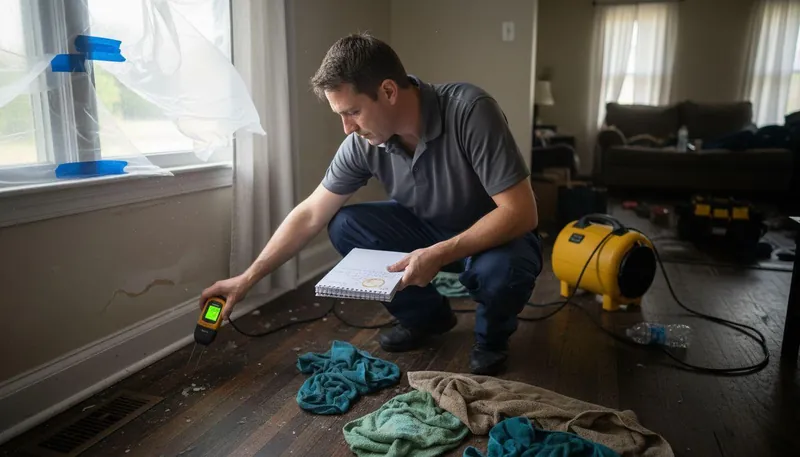
The short version
For emergency water damage in Houston, stop the water at the nearest valve, keep clear of wet electrics and gas appliances, and photograph everything. Call your insurer, then a restoration provider. Wet materials need to be dry in 24 to 48 hours, per the EPA, to avoid mold.
What counts as emergency water damage in Houston?
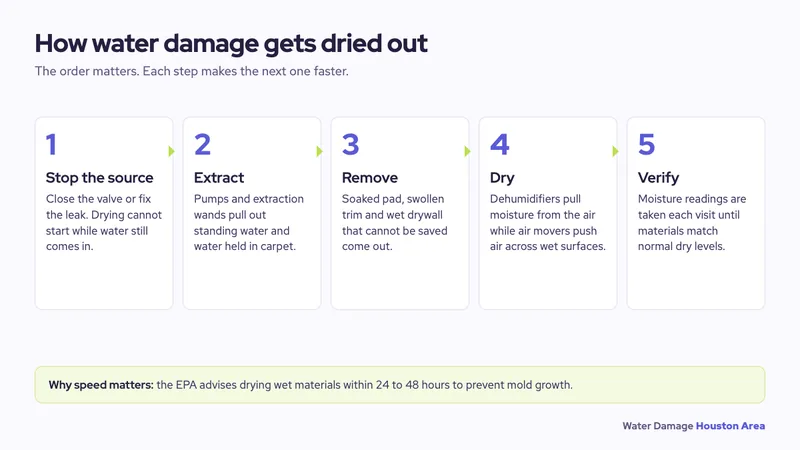
Call it an emergency if water keeps flowing, if it has reached wiring, or if it is working into drywall, insulation or a subfloor. A house left wet overnight is already behind, because the EPA advises drying wet materials within 24 to 48 hours to prevent mold.
Wiping up one drip you noticed early is routine. A supply line that split in an empty house and ran unseen until someone came home is the real thing.
- A pipe that split or burst, whether in the attic, an exterior wall or the cabinet under a sink
- A water heater that gave out, or a washing machine or dishwasher hose that let go
- A wet ceiling traced to an attic AC unit, the roof or a bathroom upstairs
- A toilet overflow, or sewage coming up a floor drain
- Street or bayou water entering the house after heavy rain
- Several rooms wet, or water that has been sitting for a day
What should you do in the first hour of a water emergency?
Shut off the water, make the room safe, then take photos of everything before you touch it. After that, call your insurer and a restoration provider. The order holds for a pipe, an appliance or the roof, and it goes faster than most people expect.
- Stop the source. Close the nearest fixture valve, the water heater inlet or the house shutoff.
- Kill power to the wet area. Only from a dry spot, and only at the panel if you can reach it without stepping in water.
- Get people and pets out of wet rooms if the water is dirty, deep or near outlets.
- Photograph and film the water, the source and the damaged items before you move anything.
- Call your insurer. Triple-I says to reach your agent or company immediately and to take reasonable steps to protect the property.
- Call a restoration provider and describe the water source, the rooms affected and how long it has been wet.
- Lift small items off wet floors and put foil or plastic under furniture legs on wet carpet.
Do not start tearing out walls or carpet before you have photos. Triple-I says to keep damaged items until the adjuster has visited, and to hold off on major permanent repairs until then.
How do you shut off the water in a Houston house?
Close the closest valve first, whether that is the fixture stop under a sink or toilet, the cold inlet on the water heater, or the main shutoff where the line enters the house. If none of those works, the city meter box near the street has a valve, but it may need a special tool.
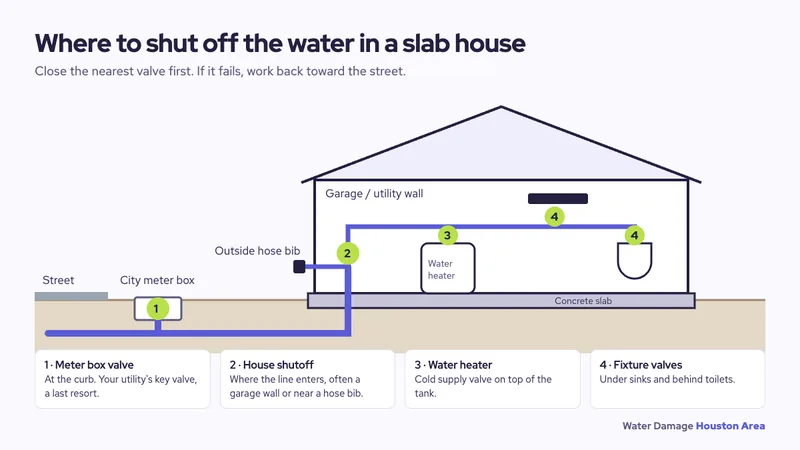
Learn where these are before you need them. Check an outside wall, the garage and the meter box, and note that a water heater in the attic or garage has its own inlet valve.
If a shutoff valve will not turn, do not force it with a pipe wrench. Call a plumber, and tell the restoration provider the water is still running.
A leak that never stops even with fixtures off may be under the slab. The slab leak guide covers the warning signs.
Is it safe to stay in the house with power and gas on?
Not if water is near outlets, the panel or a gas appliance, or if the water is dirty or deep. Stay out of the wet area, turn power off from a dry spot, and do not touch electrical equipment while standing in water. When in doubt, leave and call for help.
- Do not use a wet vac, space heater or extension cord in or near standing water.
- If your water heater or furnace sits in a wet area and is gas-fired, have it checked before it is relit.
- If you smell gas, leave and call the gas utility from outside.
- Ready.gov says a foot of moving water can carry a vehicle off and six inches can put a person on the ground. Do not wade or drive through flooded streets.
Our guide on whether it is safe to stay in a water-damaged home covers air quality, sleeping arrangements and when to leave.
Is it clean water, grey water or sewage?
Restoration providers sort water into three categories using the IICRC S500 standard. The category decides what can be dried in place and what must be removed. Rising bayou or street water is the worst category, and it is the one Houston homeowners meet after a flood.
| Category | Typical source | What it usually means |
|---|---|---|
| 1. Clean water | A burst pipe or a failed supply line | Drying in place is often possible when work begins quickly. |
| 2. Grey water | Washing machine or dishwasher discharge, or a toilet overflow with no waste in it | The carpet pad normally comes out, and surfaces get cleaned before drying starts. |
| 3. Grossly contaminated | Sewage, rising flood water from rivers and streams, outside surface water | Anything porous the water reached is usually taken out, and workers wear protective gear. |
Give clean water a day or two in a warm house and it can end up treated as grey water.
If the damage came from sewage or other contaminated water, the EPA advises bringing in a professional who has dealt with contaminated-water damage. Details are in our sewage backup cleanup guide.
What if a pipe bursts at night?
Shut off the water at the house main, open a faucet to relieve pressure, and switch off power to any wet room before you do anything else. Then photograph the damage and call your insurer. A restoration provider can be called at any hour, but confirm availability on the call.
In Houston, burst pipes tend to follow a hard freeze. The American Red Cross lists attics, garages and kitchen cabinets among the places supply pipes are most at risk. The leak often shows up when the pipe thaws, not while it is frozen.
The Texas Department of Insurance reported that from February 11 to 19, 2021, most of Texas had a prolonged stretch of frigid weather, and the damage included freezing pipes. TDI counted 112,163 claims in Harris County from that storm.
For thawing a pipe, the Red Cross warns against a blowtorch, a kerosene or propane heater and any open flame. Its safer options are towels soaked in hot water, a hair dryer or a heating pad.
Our burst pipe guide goes through draining the lines and finding the break.
What should you do if water is rising from a bayou or the street?
Put safety first and property second. Get everyone to higher ground, stay out of moving water, and do not return to a flooded house until officials say it is safe. Flood water from outside is Category 3, so the cleanup is different from a pipe leak.
Once water has receded and the house is safe to enter, photograph everything and call your insurer. Standard homeowners policies exclude flood damage, Triple-I explains, so a separate flood policy is needed. FEMA says the same: most homeowners insurance does not cover flooding.
See flood cleanup in Houston and hurricane water damage for the full steps. Why it happens here is covered in why Houston floods.
Who should you call first: a plumber, your insurer or a restoration provider?
Call whoever can stop the water first. If you cannot close a valve, that is a plumber. If the water is already stopped but the house is wet, call your insurer and a restoration provider close together, because the drying clock starts when the water does.
| Situation | Call first | Then |
|---|---|---|
| Water still running, valve will not close | A plumber | Insurer, then a restoration provider |
| Water stopped, floors and walls wet | Your insurer | A restoration provider for extraction and drying |
| Sewage in the house | A plumber for the line | A provider experienced with contaminated water |
| Flood water from outside | Local emergency services if you are unsafe | Your flood insurer, then a provider |
This site is a referral service, not a restoration company. It connects you with independent providers. Providers differ in what they offer, so confirm services, availability and pricing directly.
What happens in the first 24 to 72 hours?
In the first day the source should be stopped, standing water extracted and the area photographed. By the second day, soaked materials that cannot be dried should be out and equipment should be running. By the third day, readings should be falling at each visit.
The EPA advises drying water-damaged areas and items within 24 to 48 hours to prevent mold growth. The CDC gives the same 24 to 48 hour window after a flood and advises removing soaked carpets and upholstery that cannot be dried right away.
If day two arrives and nothing is drying yet, tell the provider when you call, since that changes what equipment they need to bring. For more on how that work is measured, see water mitigation and water removal and extraction.
Will homeowners insurance pay for emergency water damage?
Often yes for sudden plumbing, appliance or roof leaks, and usually no for flood water from outside. NAIC describes plumbing and roof-leak water damage as typically covered, but not ground water or rain runoff. The wording of your own policy settles it.
On standard forms, Triple-I names accidental discharge or overflow from plumbing, heating, air conditioning or a household appliance as covered perils. It adds that a typical homeowners policy leaves out sewer backups, which need an endorsement or separate cover.
The Insurance Information Institute puts the rate at about one in 60 insured homes with a water damage or freezing claim each year, at an average of $15,400 across 2019 to 2023.
The Texas Department of Insurance says your company has 15 business days to say it got your claim, and 15 business days after getting what it needs from you to say if it will pay. The company can extend that by 45 days with a reason, and a weather catastrophe can add more. See the insurance claims guide, and the restoration cost guide for sourced price ranges.
Sources: EPA, A Brief Guide to Mold, Moisture and Your Home; EPA, Mold Cleanup in Your Home; IICRC S500; American Red Cross, Frozen Pipes; Ready.gov, Floods; CDC, About Mold and Your Health; Insurance Information Institute, Homeowners and Renters Insurance; Triple-I, Which disasters are covered; Triple-I, Settling claims after a disaster; NAIC, Homeowners Insurance; FEMA, Don't have flood insurance; TDI, Winter Storm Uri losses report; TDI, Getting your insurance claim paid.