The short version
To choose a restoration company in Houston, get an itemized written estimate, read all paperwork before signing, ask to see moisture readings and find out which licenses apply. Do not give in to pressure to sign at once. This site refers callers to independent providers and ranks none of them.
How do I choose a restoration company in Houston?
Run six checks before any signature: scope of work, an itemized estimate, how moisture will be monitored, what the forms say, how the provider works with your insurer, and which licenses cover the job. If a provider answers all six clearly and puts the answers on paper, that is a workable choice.
- Scope on paper. Rooms involved, what gets torn out, and what is dried where it stands.
- An itemized estimate. Triple-I recommends bids in writing that list materials and prices one line at a time.
- A monitoring plan. Moisture readings should be recorded at each visit, and you should be allowed to see them.
- Forms you have read. Anything unclear gets explained before you sign, not after.
- Insurer handling. The claim itself still goes through your own insurer.
- Licenses. Plumbing and mold work are licensed trades in Texas, covered further down.
Fit these calls in while someone is shutting off the water. Each takes a few minutes and none of it delays the dry-out. The first steps at the property are in emergency water damage restoration in Houston.
Which restoration company in Houston is the best?
This site will not name one. It refers callers to independent providers and takes no position on any of them: no rankings, no scores, no endorsements, and no company has paid for a spot on a list. A "best" label from a referral service would be marketing, not evidence.
Online lists of the best Houston water damage companies mix paid placements with averaged star ratings, and neither tells you what will happen in your house. The metro area has providers of every size, so the useful test is paperwork and plain answers. Anyone you reach through this site should clear the same bar as a company you found yourself.
What questions should I ask a restoration company?
Use the table below as a phone script and jot down every reply. The questions cover how the work will be carried out and how it will be billed. A solid provider takes them in stride, since any customer could reasonably ask the same things.
| Ask this | Reason | Reassuring reply |
|---|---|---|
| Is the estimate itemized and in writing? | One lump sum hides what each part costs | Yes, with equipment, labor and materials listed apart |
| What gets removed, and what will you try to keep? | Demolition drives cost and rebuild work | A room-by-room plan, with a reason for each removal |
| How will you track drying? | Readings show whether materials are actually drying | Numbers logged at every visit and shared when asked |
| Which water category applies? | IICRC S500 handles clean and contaminated water differently | A clear answer based on the source, with a matching plan |
| Can I read the paperwork before signing? | Forms may carry payment and insurance terms | Yes, plus a walk through what each section does |
| Who holds the license for plumbing or mold work? | Texas licenses those trades on their own | A named holder whose license you can look up |
| Who will actually come to the house? | You need to plan around visits | A named contact and a schedule for monitoring checks |
Write down the date and who answered. When an invoice contradicts what you were told on the phone, that record counts for a lot.
What licenses does a restoration company need in Texas?
That depends on the task. Plumbers are licensed by the Texas State Board of Plumbing Examiners, and mold remediation by the Texas Department of Licensing and Regulation. Neither license covers drying a structure, so ask which ones apply to the work being quoted for your house.
The Plumbing Examiners board describes its job as licensing and regulating the plumbing trade in Texas, and it encourages consumers to hire a licensed plumber. A public license search is linked from its site. If the job includes fixing a leak or replacing pipe, ask who holds the plumbing license and look that name up.
TDLR states that it licenses and regulates people and companies that clean up and remove mold, with a Mold Remediation Contractor license type. Its FAQ says unlicensed people may clean visible mold covering under 25 contiguous square feet, yet a licensed contractor hired for a small area must still follow the law and rules. TDLR also offers a license search. If mold turns up, mold after water damage in Houston lays out what comes next.
This page found no statewide license for general contractors or restoration companies as a category, so do not assume one. Ask the provider to state in writing which licenses and which insurance relate to the scope it is quoting, then verify what you can with the agencies above.
What am I signing when I approve the work?
Most often it is a work authorization, and sometimes a second form connected to how your insurer pays. Take the time to read every page, even with water standing in the house. When a clause is unclear, ask what it commits you to and hold off until you get an answer.
Forms vary between providers, so this page cannot describe a particular one. Check each form for the following:
- Scope of work. It should agree with what the phone conversation covered.
- Payment terms. Who gets billed, when money is due, and what happens if the insurer pays less than the invoice.
- Insurance payment language. Some forms let a provider work directly with your insurer or collect the insurer's payment, often called an assignment of benefits. Ask which of your rights you hand over or share.
- Empty fields. Never sign a form that someone could complete after you leave.
- Your own copy. Walk away with a signed copy, or photos of every page.
For what a document means in law, ask a lawyer or your insurance agent. A provider who refuses to let you read first, or brushes off a question about a line, has shown you how the job may unfold.
How do I spot a storm chaser after a Houston flood or hurricane?
A storm chaser is an out-of-area crew that shows up after a major storm and pushes for fast signatures. Typical signs: knocks on the door, a demand to sign now, no local address you can verify, and no written scope. Slow down and put them through the same checks as anyone else.
After a hurricane or big flood, demand for dry-out help jumps and a few people exploit it. Crews that travel in are not automatically a problem, and local names are not automatically safe. What counts is the paperwork, not the plates on the truck. Get an estimate in writing, ask which licenses apply, and spend a few minutes looking up any license holder named.
Be wary of a big deposit with no account of what it pays for. For storm-specific background, read about hurricane water damage in Houston and flood cleanup.
Why do I need a written, line-item estimate?
Without one you cannot compare two quotes or audit the final invoice. Triple-I recommends written bids that list materials and prices line by line, and that holds true whether you pay yourself or an insurer does. The itemized version is your baseline for every later conversation.
A workable estimate puts equipment, labor, materials and any hauling or disposal on separate lines. One total, or a single entry reading water mitigation, leaves nothing to verify. Scope often expands after walls are opened, so ask how added work will be handled. Hearing about extra charges beforehand beats finding them on the last page of the bill.
General ranges for what jobs cost appear in the water damage restoration cost guide, though nobody can price your job from a distance.
What should daily drying readings show?
Each visit's numbers should be lower than the last one for every wet material. The provider takes meter readings in walls, floors and framing, writes them down and compares them against dry levels for that material. A reading that stops falling means the drying plan needs to change.
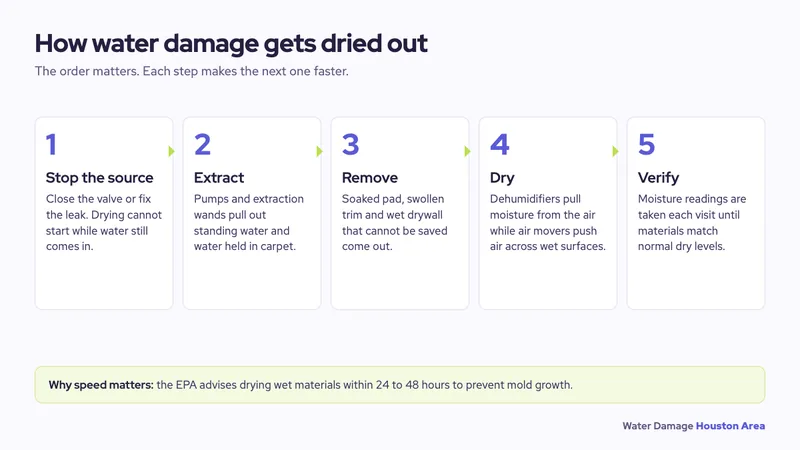
Request the log. Providers who keep readings usually have no problem showing them, and the log supports the equipment days charged on the invoice. Days billed with no readings behind them are a fair thing to question. See the water mitigation page for the sequence of steps and structural drying for how moisture gets tracked.
What are the red flags with a restoration company?
Watch for pressure to sign immediately, no written estimate, vague billing and reluctance to share readings. Any single one deserves a pause. When two or more show up together, call a different provider instead of hoping the pattern changes.
- Pressure to sign right away. Protecting the property comes first, and reading the forms can follow a few minutes later.
- No written estimate, or a vow to settle the price afterward.
- Invoices showing one lump sum with nothing itemized.
- Unwillingness to show moisture readings or photos of the work.
- A large payment requested up front with no explanation.
- Urging you to discard damaged belongings before the adjuster looks. Triple-I advises keeping damaged items until the adjuster has visited.
- Fear-based selling. The EPA advises drying wet materials in the first 24 to 48 hours, but urgency does not excuse skipping the paperwork.
- Advice not to contact your insurer.
Good signs are the reverse: a written scope, itemized prices, logged readings and calm answers to everything you ask.
What should I do if I think I was overcharged?
Begin by requesting the itemized invoice and the drying log, set both beside the estimate, and then send the provider specific questions in writing. If an insurer is paying, bring the adjuster into it as well. Take these steps in order.
- Request the itemized invoice along with all moisture readings and photos.
- Lay it next to the written estimate. Flag each charge that is new, higher or unexplained.
- Have the provider explain the flagged charges in writing, and save every message.
- Call the adjuster when a claim is open, and pass along the invoice and readings.
- Check for an appraisal clause. Triple-I notes that many policies permit an independent appraisal, where each side names an appraiser, the two choose an umpire, and agreement by any two settles it.
- Reserve the state for insurance disputes. The Texas Department of Insurance handles complaints about insurance companies.
The TDI page "Get help with an insurance complaint" has a filing link, and its general questions line is 800-252-3439. It covers quarrels with an insurer, not billing disagreements with a provider. Triple-I also cautions that public adjusters can charge as much as 15 percent of a settlement, so check them with the BBB and the state insurance department. The insurance claims guide walks through the whole process.
Does insurance change how I choose a company?
It changes your first moves rather than who may dry the house. Triple-I's advice is to contact your agent or insurer promptly, keep the property from getting worse, and postpone large permanent repairs until the adjuster has looked at the damage.
Take photos before any work begins and hold on to every receipt. A few policies name preferred vendors, so ask your insurer whether you are required to use one rather than guessing. Build your own file: estimate, signed authorization, readings, invoice. Water coming in from outside raises a separate coverage question, because FEMA states that most homeowners insurance does not cover flooding. Before approving a big scope, read what water damage insurance usually covers.
What is a water mitigation company?
Mitigation means limiting the spread of damage: pulling out standing water, removing materials that cannot be saved, drying the structure and recording the readings. Reconstruction is separate, and covers rebuilding walls, floors and finishes afterward. Some companies do both, others only one.
Find out which services a provider performs and whether the estimate you hold covers mitigation alone. Water damage repair explains the rebuild side, and it is worth confirming directly whether a provider deals with mold if it appears.
How does this site's referral work?
When you call or send a request, the site passes you to an independent restoration provider that accepts water damage calls in your area. The site does not do the work, is not a contractor and has no say in prices. Scope and terms come from the provider.
For more on the setup, read how the site works and the editorial policy. The checklist here applies to any provider, no matter how you found them, and you are free to turn down a referral and phone someone else.
Sources: Triple-I, Settling insurance claims after a disaster; Texas Department of Insurance, Get help with an insurance complaint; Texas State Board of Plumbing Examiners; TDLR, Mold Assessors and Remediators; TDLR mold FAQ; EPA mold and moisture guide; IICRC S500; FEMA, flood insurance FAQ.