The short version
A water mitigation invoice should break the work into extraction, demolition, drying equipment by the day, treatment and monitoring, each with a unit, quantity and price. Ask for the drying log and photos, compare dates and square feet, and put questions in writing before you pay. Providers differ, so confirm terms directly.
What is a water mitigation invoice?
A water mitigation invoice is the bill for stopping the damage from spreading: pulling out standing water, removing wet materials and running drying equipment. It is separate from the repair bill that rebuilds walls and floors afterward. Reading it line by line shows what was done and what you were charged for.
The invoice is the paperwork behind the emergency work, and it often arrives before anything is rebuilt. That is why a water mitigation invoice gets questioned: it lands while you are stressed and the numbers look big. This site is a referral service, not a contractor, so it cannot tell you what a given provider should charge. It can show you what the lines mean and what a clear invoice contains. The water mitigation page explains the work itself.
What line items should a water mitigation invoice show?
A clear invoice breaks the job into labeled lines, each with a unit, a quantity and a price. Typical groups are inspection, water extraction, demolition of wet materials, drying equipment, cleaning or antimicrobial treatment, monitoring visits and disposal. Providers name and group these differently, so ask about any line you do not recognize.
| Line item | What it should show | What to ask |
|---|---|---|
| Water extraction | Area covered, water category, unit price | Which rooms, and how was the area measured? |
| Equipment | Each type, how many units, how many days | Do the day counts match the drying log? |
| Demolition | Material removed, location, quantity | Do the photos show that material was wet? |
| Cleaning and treatment | Surfaces treated, product type if listed | Why was this needed for this water category? |
| Monitoring | Visit dates and readings taken | Can I see the readings for each visit? |
| Disposal and labor | Hours or loads, and what they cover | Is this already inside another line? |
Triple-I advises getting written bids with materials and prices listed line by line. The same standard works for an invoice you already hold. A single lump sum with no breakdown is not enough to check against the work.
How are water extraction charges calculated?
Extraction is usually priced per square foot of affected floor, and the rate depends on the water category. The IICRC S500 standard sorts water into Category 1 clean, Category 2 gray and Category 3 grossly contaminated. Dirtier water means more labor and protective gear, so the unit price rises with the category.
Fixr's national cost guide, updated January 31, 2025, lists extraction at $3.75 to $4.25 per square foot for clean water, $4.10 to $6.50 for gray water and $7 to $7.50 for black water. Those are national figures, not Houston quotes, and providers set their own rates. Use them only to sense whether a line is wildly off.
The better check is the quantity. Ask how many square feet were billed and compare that to the rooms that were actually wet. A slab-on-grade Houston house often has one level of flooring, so a bill for far more square feet than the wet area deserves a question. Also check that the category on the invoice matches the source. A supply line break is normally Category 1, while sewage and rising flood water are Category 3. The water removal page covers the extraction step.
Why are equipment charges listed by the day?
Drying equipment is billed per unit per day because each fan or dehumidifier is on your property for a set stretch of time and is not available for another job. A line such as three air movers for four days means each unit is counted separately for each day it ran.
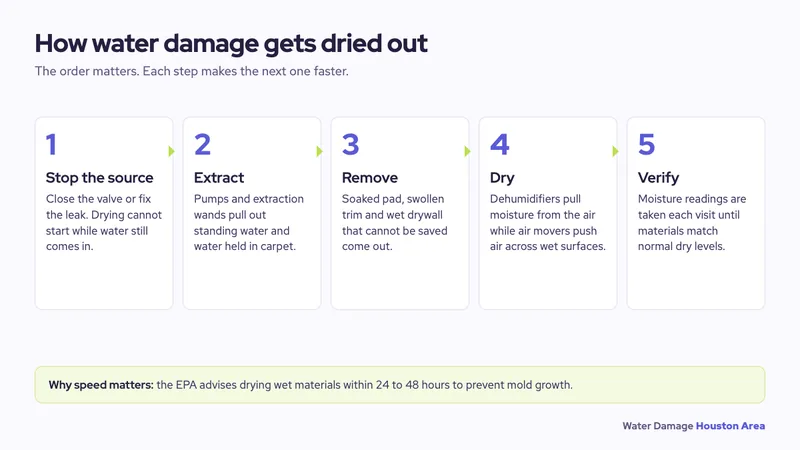
That makes equipment the line where small errors add up fastest. Ask for three things: the number of units, the start and end date, and the reason each piece was placed. Air movers, dehumidifiers and air scrubbers do different jobs, and the IICRC S500 describes how the drying plan is set up. The EPA advises drying water-damaged areas and items within 24 to 48 hours to prevent mold growth, so equipment often goes in right away.
A fair question is why equipment stayed on a day after readings showed the material was dry. The drying log should answer it. Many providers drop equipment as rooms reach their targets, and the invoice should show that. See structural drying for how the equipment and readings fit together.
What should drying logs show?
A drying log records moisture readings and equipment checks over the course of the job. It should list the date, the rooms or materials measured, the readings, humidity or air readings, and which equipment was running. The log is the proof that the days billed were days of real drying work.
Ask for the log along with the invoice. A good one lets you see a trend: readings high on the first visit and lower on each later visit until the material reaches the target the provider set. If the readings never change, equipment may be in the wrong place. If they drop quickly, equipment should come out sooner. Our guide to moisture meter readings explains what the numbers mean.
What is a Xactimate-style line item?
A Xactimate-style line item is a priced entry from estimating software that insurers and many contractors use. Each line names a task, such as removing a section of drywall or setting a dehumidifier, and gives a unit, a quantity and a unit price. The total is the sum of those lines.
The format is useful because it is easy to compare. If your provider writes a bill by hand and your insurer writes an estimate in software, you can line up the two and see where they differ. Differences usually come from quantity or scope, not from the math. One side may count 300 square feet and the other 220, or one may include a task the other left out.
You do not need the software to read the lines. Check that each one names a task, a unit, a quantity and a price. Providers differ in how they price and group work, so ask yours how its lines map to an insurer's estimate.
What should I question on a water mitigation invoice?
Question lines that you cannot match to the work, the dates or the photos. Common flags are quantities larger than the wet area, equipment days after the drying log shows dry readings, charges that appear to repeat, and vague lines with no unit or quantity. A question is not an accusation; most differences have a plain explanation.
- Square feet. Do the numbers match the rooms that were wet?
- Equipment days. Do start and end dates match the log?
- Repeated work. Is labor billed on its own and again inside another line?
- Demolition. Is every item removed supported by a photo or reading?
- Water category. Does it fit the source of the water?
- Authorization. Did you sign for the scope that was billed?
Authorization matters more than most people expect. Work that went beyond what you approved is a fair thing to raise early. The guide to choosing a restoration company lists what to ask before work starts, when it is easiest to agree on scope.
What should I do when the invoice arrives?
Do not pay or sign off on the first read. Request the supporting records, compare them to the invoice, and send your questions in writing. Triple-I advises saving receipts and keeping photos, and it says to hold off on major permanent repairs until the adjuster has assessed the damage.
- Ask for the full package: itemized invoice, drying log, photos and the signed work authorization.
- Match the dates. Compare equipment days to log entries.
- Match the area. Compare billed square feet to the wet rooms.
- List questions in writing and keep the reply.
- Send the invoice to your insurer if you have a claim open, and ask what it will review.
- Pay what is clear and settle the disputed lines before you pay the rest, if the provider agrees.
Will my insurance pay the mitigation invoice?
It may, depending on the cause of the water and your policy. The NAIC says water damage from a home's plumbing or a roof leak is typically covered, while damage from ground water or rain runoff is not. Triple-I says standard policies exclude flood, so flood water needs a separate flood policy.
Triple-I says to take reasonable steps to protect the property from further damage, and mitigation is often that step. Ask your insurer before work starts whether it has a preferred process, and tell it what you spend. Save every receipt. The insurance claims guide walks through the claim steps in Texas.
If an insurer pays less than the invoice, the gap is often scope or price. Triple-I says many policies allow an independent appraisal if you disagree. The Texas Department of Insurance says a company that rejects a claim must say why in writing. The remainder, if any, is a matter between you and the provider, so ask about it before you sign for the work. For costs in general, see water damage restoration cost in Houston.
How do I dispute a charge on a mitigation invoice?
Start with the provider, in writing, naming the line and the reason you question it. Attach the log or photo that does not match. Most disputes end there. If the provider and your insurer disagree, ask both to explain the difference by line, since it usually comes down to quantity or scope.
If the dispute is with your insurer over what it will pay, the Texas Department of Insurance accepts complaints and publishes a line for general questions at 800-252-3439. If it is with the provider over work you did not approve, keep your signed authorization and the correspondence. This page does not give legal advice, and if the amount is large, a consumer attorney can tell you your options.
Ask each provider up front what its invoice will look like and whether it keeps drying logs. More background is in the water damage guides.
Sources: Triple-I, Settling insurance claims after a disaster; Triple-I, Which disasters are covered by homeowners insurance; NAIC, Homeowners Insurance; IICRC S500; EPA, A Brief Guide to Mold, Moisture and Your Home; Fixr, Water Damage Restoration Cost; TDI, Getting your insurance claim paid; TDI, Get help with an insurance complaint.